
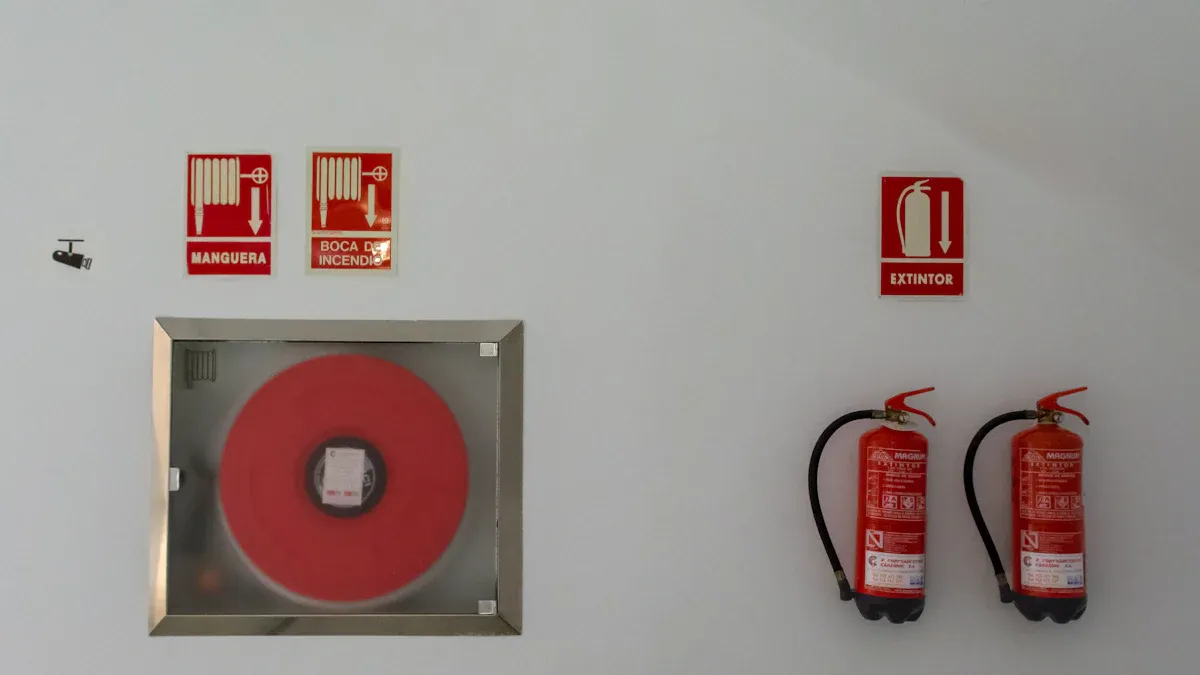
Identifying trustworthy and high-quality fire fighting equipment suppliers in China is a critical task. The Chinese fire equipment industry is robust, with its market size surpassing 150 billion yuan and projected to exceed 200 billion yuan by 2025. This growth reflects a dynamic sector. Businesses must ensure product reliability and compliance with international standards. For instance, Zhejiang World Fire fighting equipment provides International standard fire fighting equipment. Securing effective communication and support from fire fighting equipment suppliers is also essential. This is particularly true when seeking customized fire fighting solutions for oil and gas industry. The market shows a projected growth rate of 5.5% (CAGR 2026-2033).
Key Takeaways
- Clearly define your needs for fire fighting equipment. Know the types, certifications, budget, and quantity you require.
- Carefully check potential suppliers. Use B2B platforms, look at their online presence, and verify their business licenses.
- Ensure the supplier has good quality control. Ask about their quality systems, product certifications, and consider factory inspections.
- Evaluate the supplier’s communication and support. Check how fast they respond, their English skills, and their after-sales service.
- Ask for references or case studies. This shows their past work and helps you trust their ability to deliver.
Defining Your Needs for Fire Fighting Equipment
Identifying Specific Fire Fighting Equipment Types and Specifications
Before engaging with any supplier, a buyer must clearly define their specific needs. Different environments require distinct fire safety solutions. For commercial buildings, for instance, several crucial types of fire fighting equipment are necessary. Automatic Sprinkler Systems are vital, featuring piping networks with sprinkler heads to drench fires. These include Wet Pipe Systems, commonly filled with water, and Dry Pipe Systems, which use pressurized air for freezing environments. Specialized systems using inert gases suppress fires by oxygen starvation in facilities with delicate assets. Firefighters also use Standpipe Connections to link hoses to a building’s existing system for higher water flow. Other essential items include:
- Fire Extinguishers: These are the first line of defense for small fires.
- Fire Hose Reels: They provide continuous water flow for medium-sized fires.
- Fire Hydrant Valves: These allow firefighters to connect hoses for high-pressure water.
- Fire Sprinkler System: This system automatically detects heat and releases water.
- Fire Alarm & Detection System: It alerts occupants and triggers evacuation.
Understanding International and Local Certifications for Fire Fighting Equipment
Certifications play a critical role in ensuring the quality and compliance of fire fighting equipment. The UL mark, for example, signifies that an item has undergone comprehensive testing for reliable and safe performance. UL is a key independent organization that satisfies NFPA requirements, alongside FM Global and ISO. These organizations ensure products meet safety and performance standards.
| Aspect | UL Certification | CE Certification |
|---|---|---|
| Region | U.S., Middle East, parts of Asia | European Union, EEA, parts of Africa |
| Standards | NFPA 72, UL 864 | EN 54 series |
| Approval Type | Third-party independent testing and audits | Self-declaration + notified body testing |
UL Certification focuses on product safety and performance, recognized widely in North America. FM Certification emphasizes safety, loss prevention, and risk mitigation, with global recognition in industrial sectors. For fire safety equipment sold in China, manufacturers must obtain the China Compulsory Certification (CCC) mark. This national safety and quality mark is mandatory for 96 product types, including fire safety equipment. Products cannot enter or be sold in China without this registration.
Determining Budget and Volume Requirements for Fire Fighting Equipment
Establishing a clear budget and understanding volume requirements guides the supplier selection process. Prices for fire fighting equipment vary significantly based on type and complexity. For example, a Fire Hose Reel Cabinet might cost between $20 and $365 per piece, while a large Airport Rescue Fire Fighting Truck can range from $500,000 to $600,000.
| Category | Price Range (USD) | Unit | Minimum Order Quantity |
|---|---|---|---|
| Fire Hose Reel Cabinet | 20-365 | Piece | 1 Piece |
| Benz Airport Fire Fighting Truck | 500,000-600,000 | Piece | 1 Piece |
| Polyester Filament Yarn Jacket Fire Hose | 0.58-0.98 | Meter | 300 Meters |
Minimum Order Quantities (MOQs) also impact purchasing decisions. For a 1kg Dry Chemical Powder Fire Extinguisher, the MOQ is typically 480 pieces. Basic smoke detectors often have MOQs above 1000 units. However, a Fire Fighting Truck can have an MOQ as low as 1 unit. Bulk orders often lead to better discounts and negotiation opportunities.
Vetting Potential Fire Fighting Equipment Suppliers
Utilizing Reputable B2B Platforms and Industry Directories
To begin vetting potential suppliers, businesses should utilize reputable B2B platforms. These platforms serve as valuable starting points for identifying manufacturers. Alibaba and Made-in-China are prominent examples. They host numerous Chinese suppliers of fire fighting equipment. Buyers can browse company profiles, product listings, and initial certifications. These directories offer a broad overview of the market. They help narrow down the initial search for suitable partners.
Assessing Online Presence and Professionalism of Suppliers
A supplier’s online presence reveals much about their professionalism. Businesses should look for a consistent Name, Address, and Phone number (NAP) across all online platforms. This includes their website, Google My Business profile, and social media. A verified and optimized Google My Business profile acts as a digital storefront. It shows location, hours, and contact information. A mobile-optimized website design ensures easy navigation on smartphones. It also shows clear calls-to-action. Robust customer feedback systems, where suppliers collect and respond to reviews, build trust. These elements collectively indicate a professional and reliable operation.
Verifying Company Registration and Business Licenses
Verifying a supplier’s legal standing is crucial. Buyers must request specific documents from the manufacturer. These include the Business License (营业执照), Unified Social Credit Identifier (USCI), Export License, and Tax Registration Certificate. Buyers can then verify these documents using the National Enterprise Credit Information Publicity System (NECIPS) at gsxt.gov.cn. Enter the company name or USCI number on the NECIPS website. Cross-reference the company details with the provided license. Examine the registration date; older companies often show more reliability. Check for any listed legal disputes or violations. Confirm the registered capital and business scope. Be cautious of blurry certificates or incorrect company names.
Evaluating Years in Business and Specialization in Fire Fighting Equipment
A supplier’s longevity in the market often indicates stability and experience. Businesses should prioritize manufacturers with a proven track record. Many years in operation suggest a company has navigated various market conditions and consistently delivered products. This history builds trust and demonstrates reliability. An established supplier likely possesses refined manufacturing processes and a deeper understanding of industry demands.
Specialization also plays a crucial role. Suppliers focusing solely on fire safety solutions typically possess deeper expertise. They dedicate their resources to research, development, and production within this specific niche. This focus often results in higher quality products and a better understanding of international standards. For example, a company that integrates design, R&D, production, and sales for a comprehensive range of fire fighting equipment, including hydrants, nozzles, and various extinguishers, shows a strong commitment to the sector.
Companies with extensive facilities, such as those covering 30,000 square meters and employing over 150 professionals, demonstrate significant operational capacity. Such scale allows for advanced equipment and strict quality control during production. This specialization ensures products meet global customer requirements. It also confirms compliance with international standards. A supplier’s long-standing presence and dedicated specialization in fire fighting equipment offer significant advantages to buyers.
Ensuring Quality Control and Manufacturing Excellence for Fire Fighting Equipment
Inquiring About Quality Management Systems (e.g., ISO 9001)
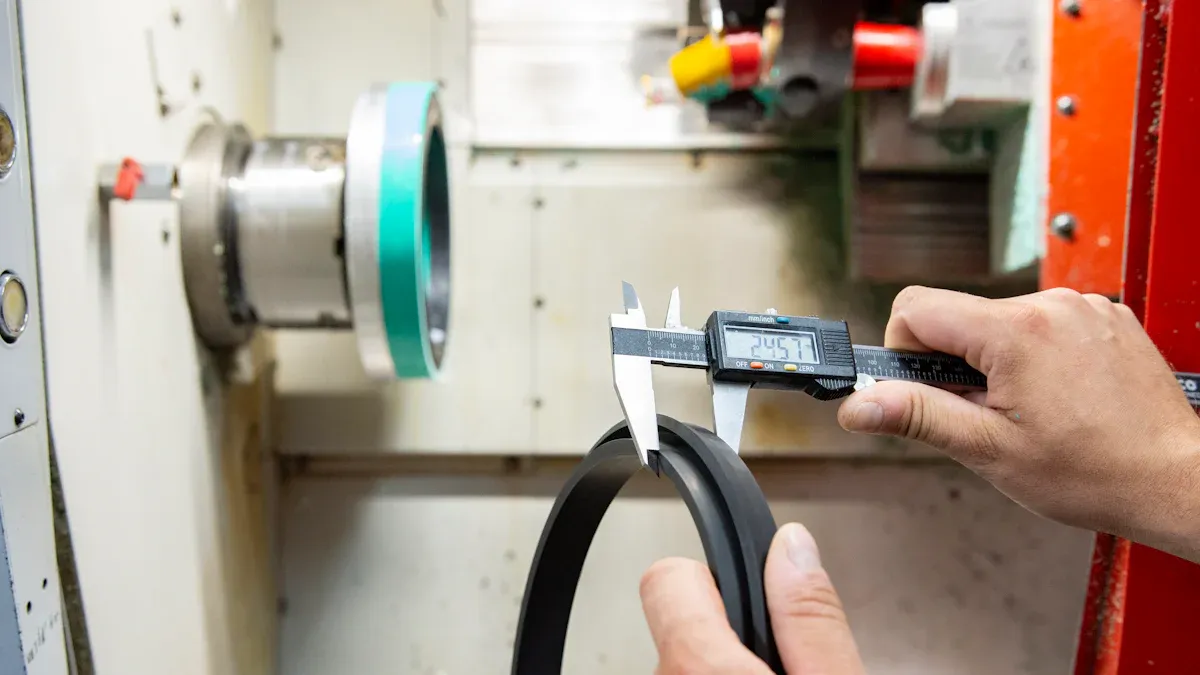
Buyers must prioritize suppliers with robust quality management systems. ISO 9001 certification demonstrates a commitment to consistent quality. This international standard outlines requirements for a quality management system. A certified supplier follows documented processes for production, inspection, and delivery. They also maintain records of these activities. This ensures product reliability and customer satisfaction. Inquiring about a supplier’s ISO 9001 certification status provides assurance. It indicates the supplier adheres to globally recognized quality benchmarks.
Requesting Product Certifications and Test Reports for Fire Fighting Equipment
Product certifications are crucial for verifying compliance and safety. Buyers should always request relevant certifications for the specific fire fighting equipment they intend to purchase. These may include UL, FM, CE, or CCC marks, depending on the target market. Test reports provide detailed evidence of product performance. They show how products fared under various conditions.
A buyer should request reports that can be generated instantly when an inspector or insurer asks for proof, as mentioned in the context of Computerized Maintenance Management Systems (CMMS) for fire suppression systems.
These reports offer transparency and build trust. They confirm the product meets specified standards and performance criteria.
Understanding Manufacturing Processes and Technology
Understanding a supplier’s manufacturing processes and technology reveals their production capabilities. Advanced factories often employ cutting-edge machinery. This leads to higher precision and efficiency.
- A Penta 30K laser cuts up to two inches of steel with beveled edges, eliminating manual sanding.
- An automated panel bender performs multiple bends significantly faster than traditional presses.
- A semi-automated folding machine allows a single operator to perform complex bends safely and efficiently.
- Automated rail welding systems reduce welding time by up to two-thirds.
- Hand-held laser welding technology provides precise results with minimal material warpage.
- Buffing robots and an AI-enabled sanding system ensure consistent and efficient metal panel preparation.
- Advanced paint booths and curing ovens are found within new, expanded paint facilities.
Such technologies indicate a supplier’s investment in quality and innovation. They also suggest a capacity for large-scale, high-quality production.
Considering Factory Audits or Third-Party Inspections
Buyers should seriously consider factory audits or third-party inspections. These steps provide crucial insights into a supplier’s operational capabilities and quality control. A factory audit involves an on-site visit to the manufacturing facility. Auditors assess production processes, equipment, and quality management systems. This direct observation helps verify the supplier’s claims and ensures they meet expected standards. It also identifies potential risks before production begins.
Third-party inspections offer an impartial assessment of product quality. Independent inspectors can perform checks at various stages of production.
- Pre-Production Inspection: This verifies raw materials and components meet specifications. It ensures the supplier uses correct materials from the start.
- During Production Inspection (DUPRO): Inspectors monitor the manufacturing process. They check for quality issues as products are being made. This allows for early correction of defects.
- Pre-Shipment Inspection (PSI): This final check occurs when the order is complete. Inspectors examine finished products for quality, quantity, packaging, and labeling. They ensure the fire fighting equipment meets all agreed-upon requirements before shipment.
Engaging a reputable third-party inspection company adds an extra layer of assurance. These companies employ experts familiar with international quality standards. They provide objective reports, giving buyers confidence in their purchase. This proactive approach minimizes the risk of receiving substandard products. It protects the buyer’s investment and reputation.
Evaluating Communication, Support, and Logistics for Fire Fighting Equipment
Assessing Responsiveness and English Proficiency of Sales Teams
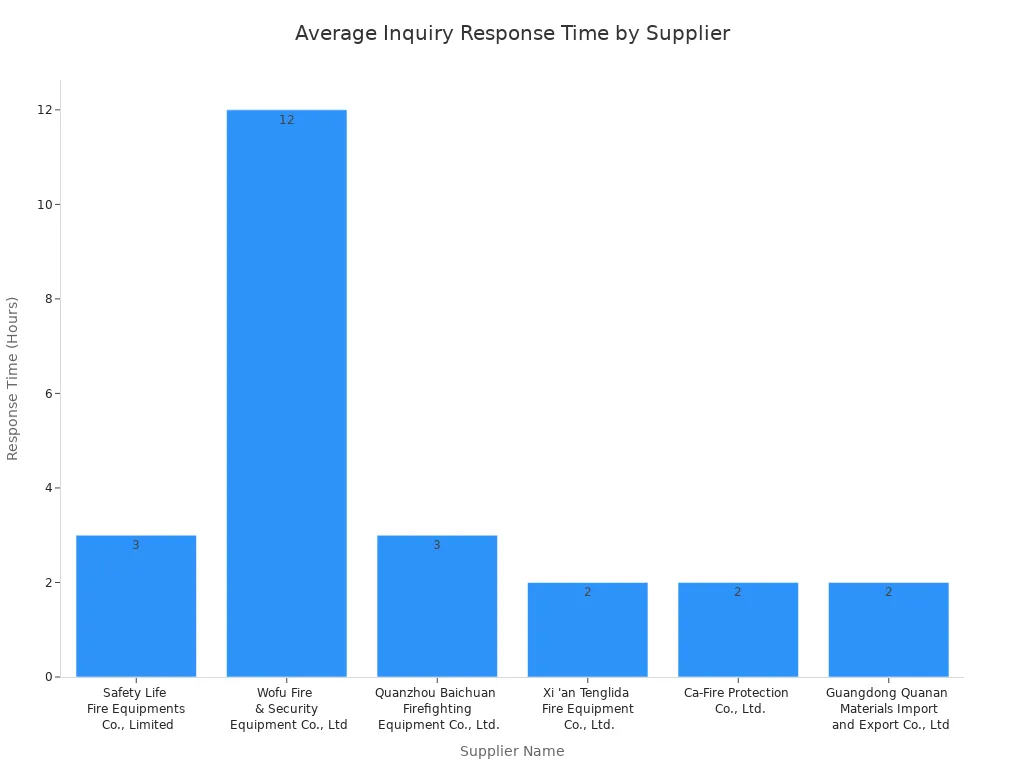
Effective communication forms the backbone of any successful international partnership. Buyers must assess a supplier’s responsiveness and the English proficiency of their sales teams. Quick and clear communication minimizes misunderstandings and speeds up the procurement process. For initial inquiries, a response within four hours indicates a dedicated 24/7 sales and support team. This suggests a low-risk and quick problem-solving experience. A response within 12-24 hours typically signifies standard local office hours. This is reliable but may involve time zone delays. For more complex inquiries requiring a detailed quote, a professional manufacturer should provide a preliminary estimate within 24 hours. They should also offer a comprehensive, specified quote within 48 to 72 hours.
| Supplier Name | Average Response Time |
|---|---|
| Safety Life Fire Equipments Co., Limited | ≤3 hours |
| Wofu Fire & Security Equipment Co., Ltd | ≤12 hours |
| Quanzhou Baichuan Firefighting Equipment Co., Ltd. | ≤3 hours |
| Xi ‘an Tenglida Fire Equipment Co., Ltd. | ≤2 hours |
| Ca-Fire Protection Co., Ltd. | ≤2 hours |
| Guangdong Quanan Materials Import and Export Co., Ltd | ≤2 hours |
Discussing After-Sales Service and Warranty Policies
After-sales service and robust warranty policies are crucial for long-term satisfaction. A professional after-sales team helps customers solve problems. They protect customer rights and ensure the safety of users. For example, ATI-FIRE maintains a professional after-sales team. Safety Plus Industrial Co., Ltd (Chinafiretech) provides instruction files and videos. These resources guide the installation and maintenance of fire fighting equipment such as fire extinguishers, fire hose reels, and filling machines. Suppliers should offer clear warranty terms. FENAN, for instance, offers a one-year warranty on all its products. FENAN guarantees products will be maintenance-free within the warranty period. Warranty periods can vary significantly:
- General materials and workmanship: 10 years after acceptance, unless otherwise noted.
- E-ONE aluminum and stainless steel bodies: 10-year and 20-year/100,000-mile structural warranties.
- E-ONE paint warranties: 10-year limited up to 12-year nonprorated.
- Custom chassis frame components: Minimum of 10 years/100,000 miles up to lifetime.
- Completed apparatus (Specification 1): 1 year for parts and labor, 10 years structural on body, and 10 years for paint, finish, and corrosion.
- Basic apparatus material and workmanship (Specification 2): Minimum 1 year.
- Apparatus mechanical defects in workmanship (Specification 3): 1 year for parts and labor, 7 years for paint, and 10 years for body structural.
Clarifying Shipping, Packaging, and Export Procedures
Understanding shipping, packaging, and export procedures prevents delays and unexpected costs. Different product statuses affect shipping classifications and costs.
| Product Status | Shipping Classification | Shipping Modes | Cost Implications | Operational Complexity |
|---|---|---|---|---|
| Empty Cylinders | General Cargo | FCL or LCL | Low freight cost, economical | Easy booking, minimal documentation, smooth customs clearance |
| Agent Filled, Not Pressurized | General Cargo (often accepted) | N/A | Much lower logistics cost | Simpler operation, local charging/assembly at destination |
| Fully Charged (Pressurized) | Restricted Cargo (UN1044-related rules) | N/A | Higher freight cost | More complex booking, additional documents, longer preparation time |
For products destined for the European market (EU and EEA), the CE Certificate of compliance is essential. This certificate confirms adherence to environmental, safety, and health requirements. Importers are responsible for ensuring this mandatory compliance. Products without it may be held at port or destroyed. Additionally, for electrical and electronic components within fire fighting equipment, RoHS certification is required in the EU. This certification restricts hazardous substances like mercury and cadmium, protecting human health and the environment. Any entity selling such products to EU countries must possess the RoHS certificate.
Requesting References or Case Studies from Previous Clients
Buyers gain valuable insights by requesting references or case studies from potential suppliers. These resources offer concrete evidence of a supplier’s past performance. They demonstrate the supplier’s ability to deliver quality products and services. A reputable supplier readily provides contact information for previous clients. They also share detailed accounts of successful projects. This transparency builds trust and confidence in their capabilities.
Case studies often highlight specific challenges a client faced. They then explain how the supplier’s fire fighting equipment provided an effective solution. These documents detail the scope of work, the products supplied, and the positive outcomes achieved. For example, a case study might describe how a supplier equipped a large industrial complex with a comprehensive fire suppression system. It would then outline the installation process and the system’s successful operation. Such examples illustrate the supplier’s problem-solving capabilities and product efficacy in real-world scenarios. They also showcase the supplier’s understanding of diverse industry needs.
When reviewing references, buyers should contact the provided clients directly. They can ask about the supplier’s communication, product quality, and adherence to deadlines. Inquire about any issues encountered and how the supplier resolved them. This direct feedback offers an unfiltered view of the supplier’s reliability and customer support. It helps buyers assess if the supplier aligns with their own operational expectations. Buyers should also ask about the longevity of the products and the availability of after-sales support or spare parts. Seek references from clients with similar project scopes or industry requirements.
Verifying these claims through independent sources strengthens the decision-making process. It reduces risks associated with new partnerships. A supplier’s willingness to provide such information indicates confidence in their work. It also shows a commitment to customer satisfaction. This step is crucial for establishing a long-term, trustworthy relationship. It ensures the chosen supplier can consistently meet demanding safety standards and deliver reliable solutions.
Successfully selecting a reliable fire fighting equipment supplier in China requires diligent verification. This process significantly impacts safety and operational efficiency. Building long-term, trustworthy partnerships provides numerous benefits. These alliances offer access to leading technologies and enhance service capabilities. They also ensure comprehensive solutions and shared expertise. Such partnerships deliver reliable support for all fire safety needs.
FAQ
How can I verify a Chinese supplier’s legitimacy?
Buyers should request the Business License and Unified Social Credit Identifier (USCI). They can verify these documents on the National Enterprise Credit Information Publicity System (NECIPS). This process confirms the company’s legal registration and operational status.
What certifications are essential for fire fighting equipment?
Essential certifications include UL, FM, CE, and CCC marks. UL and FM are crucial for North America, while CE is for Europe. The CCC mark is mandatory for products sold within China. These certifications ensure product safety and compliance.
Why are factory audits important for fire fighting equipment?
Factory audits provide direct insight into a supplier’s production processes and quality control. They help verify claims and identify potential risks before production starts. Third-party inspections offer impartial assessments at various production stages.
How does communication impact supplier selection?
Effective communication is vital for successful partnerships. Responsive sales teams with good English proficiency minimize misunderstandings. Quick responses indicate a dedicated support system. This ensures a smoother procurement process and faster problem resolution.
What should I look for in a supplier’s after-sales service?
Look for clear warranty terms and a professional after-sales team. They should offer support for installation and maintenance. This ensures long-term product satisfaction and protects your investment.