
Fire safety solutions constantly evolve. Innovation is crucial for effective fire fighting. The fire fighting equipment manufacturing industry anticipates significant growth. Experts project an expected CAGR of 7.2% from 2021 to 2026. This growth drives demand for advanced products like a durable fire hose nozzle and UL/FM/CE certified fire equipment. We aim to provide reliable fire safety solutions and streamline global fire safety procurement.
Key Takeaways
- New technology like AI, IoT, and drones makes firefighting safer and more effective.
- Stricter rules and more people living in cities are changing how fire equipment is made.
- The fire equipment industry is growing fast, especially in Asia-Pacific, and is focusing on eco-friendly solutions.
Technological Innovations in Fire Fighting Equipment
Technology is rapidly changing how we approach fire safety. Manufacturers are integrating cutting-edge innovations into fire fighting equipment. These advancements make operations safer, more efficient, and more effective.
AI and Machine Learning for Smart Fire Fighting Equipment
Artificial intelligence (AI) and machine learning (ML) are transforming fire fighting. These technologies help create smart equipment that can predict and respond to fire incidents. For example, ML-driven tools are now being developed to forecast flashovers in homes. This eliminates the need to rely solely on a firefighter’s experience. It also moves past simplified models.
AI also helps with evacuation planning. A “smart” recommendation system uses reinforcement learning. It analyzes changing fire conditions in large commercial buildings. This system then identifies optimal, safe, and quick evacuation routes. Furthermore, ML models monitor firefighters’ heart health in real-time. This continuous monitoring happens during training and actual emergencies. It addresses heart-related issues, which are a leading cause of death for U.S. firefighters.
Integrating AI significantly improves smart firefighting. Researchers designed an autonomous embedded system vehicle (AESV). This vehicle has various sensors like LiDAR and GPS. It navigates burning sites on its own. It captures environmental, imaging, and audio data. Then, it sends this data to a base station for analysis. This helps in making better decisions.
AI offers many benefits:
- Accelerated Early Wildfire Detection: AI monitors different data streams. It identifies fire risks much sooner.
- Optimized Resource Allocation: Predictive models forecast how fires will spread. This allows for dynamic prioritization and deployment of personnel and equipment.
- Enhanced Decision-Making: Data-driven insights reduce uncertainty. Incident commanders make faster, more confident decisions.
- Cost and Risk Reduction: Timely interventions stop fires from getting worse. This minimizes damage and operational expenses.
For instance, CAL FIRE (California Department of Forestry and Fire Protection) ran a six-month pilot program. They used AI wildfire prediction dashboards. Internal surveys showed a 15% reduction in resource over-deployment. They also achieved faster containment of small fires.
IoT and Connected Fire Fighting Systems
The Internet of Things (IoT) connects fire fighting systems. This creates a network of smart devices that communicate with each other. Several communication protocols and IoT platforms make this possible.
Leading communication protocols include:
- MQTT: This protocol is great for real-time alerts. It uses a publish-subscribe model. It needs TLS/SSL for built-in security.
- CoAP and AMQP: These are also used in communication protocol studies.
- 5G and Wi-Fi: These handle critical alerts and high-bandwidth data. 5G is especially good for ultra-low-latency video.
- LoRaWAN: This works for low-power, long-range deployments and backup messages.
- ZigBee: This connects sensors to a central hub in IoT-based fire detection systems.
Popular IoT platforms include:
- AWS IoT Core: It handles device provisioning and stream routing.
- Firebase Cloud Messaging (FCM): It sends push notifications to mobile users.
- Mosquitto: This is an MQTT broker for real-time communication.
However, deploying IoT in fire fighting equipment comes with challenges:
- Difficult Deployment and Maintenance: Installing and maintaining IoT sensors in remote, rugged wildfire areas is tough. These locations often lack infrastructure.
- Need for Robust Sensors: Sensors must withstand harsh conditions. Smoke, intense heat, and physical obstructions require durable, reliable sensors with minimal maintenance.
- Data Overload and Accuracy Issues: Managing and interpreting huge amounts of data from thousands of sensors is a big challenge. Systems need to filter data efficiently to prevent false alarms and ensure accuracy.
- Limited Decision-Making Abilities: Robots lack the critical thinking and intuition needed for complex fire scenarios.
- High Costs: Developing and deploying these robots is expensive. This makes them inaccessible to many fire departments.
- Technical Failures: Robots can malfunction, especially in extreme conditions. This can jeopardize missions.
- Latency: Data transmission across countries can increase latency. This creates safety issues for critical applications.
- SIM Management: Managing SIM cards for thousands of IoT devices to connect to cellular networks is complex.
- Evolving Regulations: Connectivity regulations change often. Devices need continuous monitoring to stay compliant.
Drone Technology in Fire Fighting Operations
Drones are becoming essential tools in fire fighting operations. They provide valuable aerial views and data. Different types of drones offer specific capabilities:
- Skydio X10: This drone is great for aerial reconnaissance, thermal imaging, and search and rescue. It has onboard AI for autonomous navigation and obstacle avoidance. It flies for 45 minutes and has a long transmission range.
- FLIR SIRAS: This drone excels at thermal imaging and hazardous material inspections. It has a 31-minute flight time and an interchangeable dual camera system.
- FLIR SkyRanger R70: This rugged drone offers high-resolution imaging and chemical sensors. It flies for 50 minutes and has a long transmission range.
- DJI Matrice 350 RTK: This drone is good for reconnaissance, thermal imaging, and search and rescue. It has a 55-minute flight time and a large payload capacity.
- Parrot ANAFI Thermal: This lightweight, foldable drone is perfect for thermal imaging and damage assessment. It has a dual camera with thermal and 4K visual resolution.
Regulatory frameworks guide drone usage in different regions. In Canada, Transport Canada’s Part IX of the Canadian Aviation Regulations (CARs) governs drones. Drones between 250 grams and 25 kilograms need registration. Pilots need Basic or Advanced RPAS Certification. Special Flight Operations Certificates (SFOC) are required for non-standard operations like Beyond Visual Line-of-Sight (BVLOS) flights. Data handling follows PIPEDA and provincial privacy laws.
In Europe, the European Union Aviation Safety Agency (EASA) provides a comprehensive framework. Regulation (EU) 2018/1139 sets common rules for civil aviation safety. Commission Implementing Regulation (EU) 2019/947 details specific drone operation requirements. EASA works with National Aviation Authorities (NAAs) to issue certificates and authorizations.
Advanced Materials for Fire Fighting Equipment Durability
The demand for more durable and lighter fire fighting equipment drives innovation in materials. Manufacturers are using advanced composites, specialized alloys, and ceramics. These materials offer superior heat resistance, strength, and corrosion resistance. For example, new composite materials make fire hoses lighter and more flexible. This improves handling for firefighters. Specialized alloys enhance the strength and heat tolerance of nozzles and valves. This ensures they perform reliably in extreme conditions. These material advancements extend the lifespan of equipment. They also reduce the overall weight firefighters carry. This improves their safety and efficiency on the job.
Smart Sensors and Predictive Analytics in Fire Fighting
Smart sensors are crucial for predictive analytics in fire fighting. They collect real-time data. This data helps forecast fire risks and equipment failures.
Here are some critical smart sensors and the data they collect:
- IoT Sensors for Real-Time Equipment Monitoring: These sensors track the status of fire safety equipment. This includes smoke detectors, sprinkler systems, and emergency lighting. They provide data for proactive maintenance.
- Advanced Sensors in Smoke and Heat Detection Systems: These sensors identify abnormal conditions. They detect smoke or high temperatures. This triggers alerts for a quick response.
- IoT Devices for Predictive Maintenance of Fire Suppression Systems: These devices monitor wear and tear in systems like sprinklers. They predict when components need replacement or servicing.
- Environmental Sensors for Hazardous Areas: These sensors monitor air quality, gas leaks, and temperature changes. They detect dangerous conditions that could lead to fires in places like chemical plants.
- GPS IoT for Fleet and Asset Tracking: These locate fire safety assets like extinguishers and hoses. They also monitor the condition of mobile fire fighting equipment.
- Environmental Sensors for Smart Emergency Evacuation Systems: These sensors provide real-time data on fire hazards and people’s locations. This guides dynamic evacuation routes.
Predictive analytics models use this sensor data to forecast risks. Intelligent fire detection systems use AI-driven analytics for real-time monitoring. For instance, a method proposed by Zhang et al. integrates multi-source sensor data with AI agents. This improves detection accuracy in complex indoor environments. It moves beyond static risk prediction to continuous monitoring and early warnings.
These models work by:
- Real-time Data Collection: Sensors gather environmental conditions. This includes temperature, humidity, smoke, and flammable gases.
- Data Analysis: Software applies predictive algorithms. It analyzes this data. It identifies patterns and potential risks.
- Integration with Historical Data: Digital systems use databases of past fire incidents, building layouts, and construction materials. This helps with comprehensive risk assessment.
- AI and Machine Learning: These models detect correlations and predict future fire events. They continuously improve accuracy with new data.
- Proactive Measures: Insights from predictive modeling lead to better decisions and prevention strategies. This includes adjusting building systems or alerting personnel.
Sensor data also helps with predictive maintenance. It schedules equipment repairs before failures happen. This reduces downtime and costs. Vehicle and equipment sensors monitor GPS location, fuel status, engine health, and maintenance needs in real-time. This optimizes fleet readiness.
Market Drivers and Regulatory Landscape for Fire Fighting Equipment
The fire fighting equipment industry does not operate in a vacuum. Powerful market forces and evolving regulations constantly shape its direction. These factors push manufacturers to innovate and adapt.
Stricter Global Safety Regulations for Fire Fighting Equipment
Governments worldwide are implementing tougher safety regulations. These rules directly influence how manufacturers design and produce fire fighting equipment. A major shift involves firefighting foams. New global regulations aim to restrict aqueous film-forming foam (AFFF) because it contains PFAS chemicals. Manufacturers are phasing out AFFF production.
Organizations are now moving to fluorine-free foams (FFF). These foams are less toxic and work just as well. For example, Europe and the UK will ban AFFF extinguishers by July 2025. By January 2026, new rules will stop ships from using and carrying fluorinated foams with PFOS. This transition to FFFs requires changes to existing equipment. FFFs have different chemical makeups and storage needs. Some FFFs are non-Newtonian, meaning their thickness changes. This requires different proportioning systems and updated sprayers to handle their varying viscosity. Fire departments also need new training, testing, and drills to understand how FFFs perform.
Regulations also impact firefighter gear. Laws are emerging to ban PFAS in apparel and textiles, including turnout gear.
- Connecticut and Vermont now ban the sale of apparel and textiles with intentionally added PFAS. Connecticut’s law requires PFAS-free turnout gear by January 2028.
- Massachusetts and New Hampshire will require disclosure of PFAS content in firefighter PPE starting January 2025.
- Massachusetts will prohibit PFAS-containing gear by 2027. California has a timeline to phase out PFAS in turnout gear starting in 2028. Rhode Island will ban the sale of PFAS-containing firefighter PPE from January 1, 2027.
- Illinois mandates PFAS disclosure and bans the manufacture and sale of PFAS-containing firefighter PPE.
- Cities like San Francisco and Austin also enacted PFAS bans for turnout gear.
- Vancouver, BC, allocated $2.8 million in 2024 to buy PFAS-free bunker gear. This shows a clear change in purchasing standards.
These regulatory changes demand significant innovation in materials and production. Manufacturers must find durable, protective materials without PFAS. These new materials must withstand extreme heat and hazardous conditions. They also need to maintain durability and protective qualities that PFAS chemistries once provided. New non-PFAS materials must pass strict safety tests. They need to meet the same performance standards as traditional PFAS-based fabrics. Manufacturers also work to ensure these new materials offer comfort, flexibility, and breathability. This helps reduce heat stress for firefighters.
Urbanization and Infrastructure Growth Driving Fire Fighting Equipment Demand
The world is becoming more urban. By 2050, experts project 68% of the global population will live in cities. This rapid urbanization, combined with significant infrastructure growth, fuels the demand for fire fighting equipment. The global construction industry expects strong support through 2026. This comes from stable inflation expectations and supportive monetary policies.
Key areas for infrastructure investment by 2026 include:
- Digital infrastructure like data centers, semiconductors, and fiber networks.
- Clean power and grid modernization.
- Energy transition projects.
Overall, the world may need $106 trillion in infrastructure investments through 2040. This includes substantial needs for transport, logistics, energy, power, and digital infrastructure.
Urbanization directly increases the need for various fire fighting equipment. Cities see rapid construction of homes, businesses, and industrial buildings. They also build many infrastructure projects. This requires widespread use of sprinkler systems, fire alarms, and smoke detectors. For example, China and India are building many new homes due to rapid urbanization and rising incomes. This greatly boosts the demand for automatic fire fighting facilities. Similarly, new commercial complexes, high-rise buildings, factories, and warehouses in urban areas need complete fire safety solutions. Government rules and building codes in cities also require these systems. This helps the market grow. The “new installation” segment for Automatic Fire Fighting Facilities is growing fast. It has a current market size of $6.0 billion and a projected Compound Annual Growth Rate (CAGR) of 6.5%.
Growing Awareness of Fire Safety and Equipment Needs
People are becoming more aware of fire safety. This growing awareness, especially after rising fire incidents in places like California and across the United States, speeds up market growth for fire safety equipment. Public awareness campaigns and insurance incentives also drive demand for modern fire suppression solutions. These campaigns often follow high-profile fire incidents and fire risk management efforts in various buildings.
Governments and non-governmental organizations (NGOs) launch many educational campaigns. They use workshops, public service announcements, and school programs. These efforts teach people about fire hazards and how to prevent them. News outlets and social media report on fire incidents. They highlight the consequences and encourage talks about prevention. Companies also include fire safety in their corporate responsibility efforts. They work with authorities for training, equipment distribution, and system installation. Governments in emerging markets are also creating stricter fire safety rules. These rules require system installations and promote accountability. Local groups and community leaders organize meetings, fire drills, and give out educational materials. This spreads awareness in areas that need it most. This growing awareness in emerging economies leads to more people adopting advanced fire safety systems, including Fire Hose Reel & Cabinet systems, to manage fire risks in crowded urban areas.
Demand for Sustainable Fire Fighting Equipment Solutions
The call for sustainability affects every industry, including fire fighting. Manufacturers are now focusing on eco-friendly materials and processes. They incorporate sustainable solutions into their products. This includes using recycled metals like aluminum and stainless steel from scrap. They also use aluminum from smelted ingots. Paints are becoming greener too. Paint primers and topcoats are now free of chrome and lead.
Technology also plays a role in sustainability. Idle Reduction Technology helps reduce the main chassis engine’s idle time. This saves fuel and extends service intervals. Electric fire trucks are also emerging. The Pierce® Volterra™ model is a notable example. These innovations show a commitment to reducing the environmental impact of fire fighting operations.
Insurance Industry Influence on Fire Fighting Equipment Standards
The insurance industry plays a significant role in shaping fire fighting equipment standards. Insurance companies aim to reduce risks and minimize potential losses from fires. They often require specific types of fire safety equipment or certifications for buildings and businesses to qualify for coverage. For example, a commercial property might need a certain type of sprinkler system or fire alarm to get insurance. Meeting these standards can also lead to lower insurance premiums. This financial incentive encourages property owners to invest in high-quality, compliant fire safety solutions. Insurers often rely on standards set by organizations like the National Fire Protection Association (NFPA) or Underwriters Laboratories (UL). Their influence pushes manufacturers to produce equipment that meets these rigorous safety and performance benchmarks. This ensures that the fire fighting equipment on the market is reliable and effective.
Regional Impact and Growth Opportunities for Fire Fighting Equipment
Asia-Pacific Market Expansion for Fire Fighting Equipment
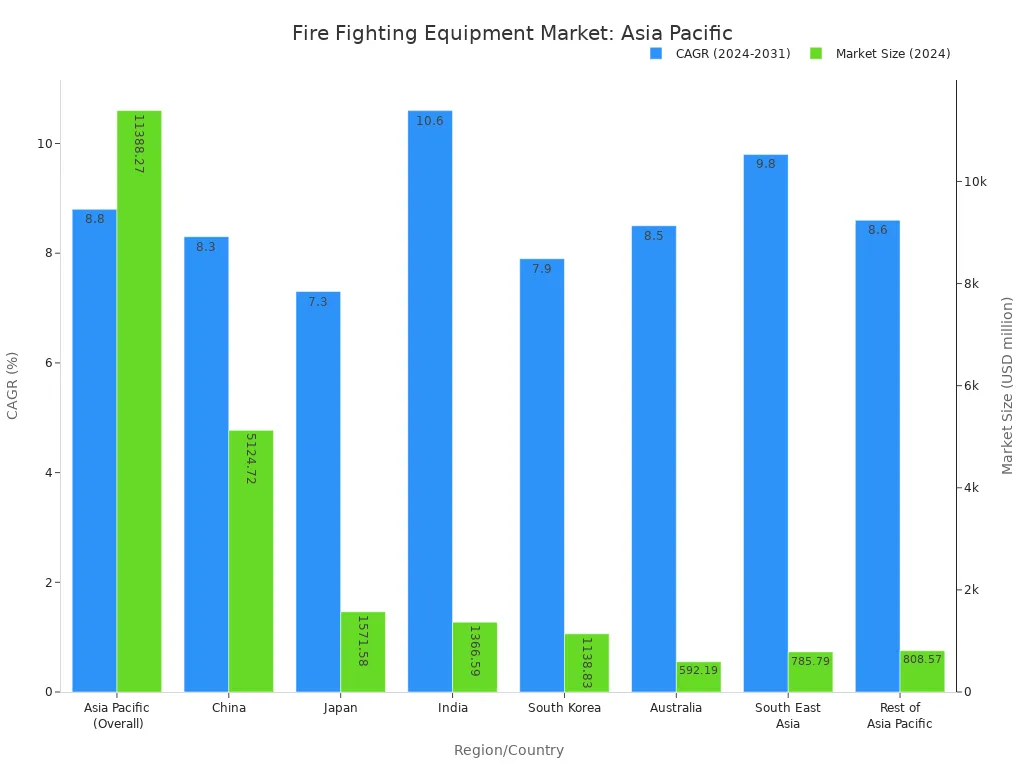
The Asia-Pacific region shows significant expansion for fire fighting equipment. The market expects an 8.8% Compound Annual Growth Rate (CAGR) from 2024 to 2031. It will reach USD 11388.27 million in 2024. Rapid industrialization and urban growth drive this. Countries like India (10.6% CAGR) and Southeast Asia (9.8% CAGR) lead this growth.
| Region/Country | CAGR (2024-2031) | Market Size (2024) |
|---|---|---|
| Asia Pacific (Overall) | 8.8% | USD 11388.27 million |
| China | 8.3% | USD 5124.72 million |
| Japan | 7.3% | USD 1571.58 million |
| India | 10.6% | USD 1366.59 million |
| South Korea | 7.9% | USD 1138.83 million |
| Australia | 8.5% | USD 592.19 million |
| South East Asia | 9.8% | USD 785.79 million |
| Rest of Asia Pacific | 8.6% | USD 808.57 million |
 |
||
| This growth comes from increased demand, new technologies, and good regional conditions. |
North American Market Maturity in Fire Fighting Equipment
North America’s fire fighting equipment market is mature but still growing. It expects a 5% CAGR from 2024 to 2031. It will reach USD 19805.68 million in 2024. Strict safety rules and urbanization drive this market. The United States holds a large share. Canada and Mexico also contribute through infrastructure projects.
| Region/Country | Market Size (2024) | CAGR (Forecast Period) |
|---|---|---|
| North America | USD 19805.68 million | 5% (2024-2031) |
| United States | USD 15,626.68 million | 4.8% |
| Canada | USD 2,376.68 million | 5.8% |
| Mexico | USD 1,802.32 million | 5.5% |
 |
||
| Major companies like Honeywell and Siemens compete fiercely. They use partnerships and new products to stay ahead. |
European Regulatory Harmonization for Fire Fighting Equipment
Europe works to harmonize fire fighting equipment standards. Technical experts from CEN/CENELEC develop these common standards. They improve existing European and test standards for construction products. These cover fire resistance and reaction to fire. The Fire Industry Association (FIA) provides guidance on the Pressure Equipment Directive (PED). This directive affects fixed gaseous systems and portable extinguishers. EN standards, like EN 469 for firefighter clothing, are widely adopted. Organizations like IFEMG also promote cross-regional dialogue for standard harmonization.
Emerging Markets for Fire Fighting Equipment in Latin America and Africa
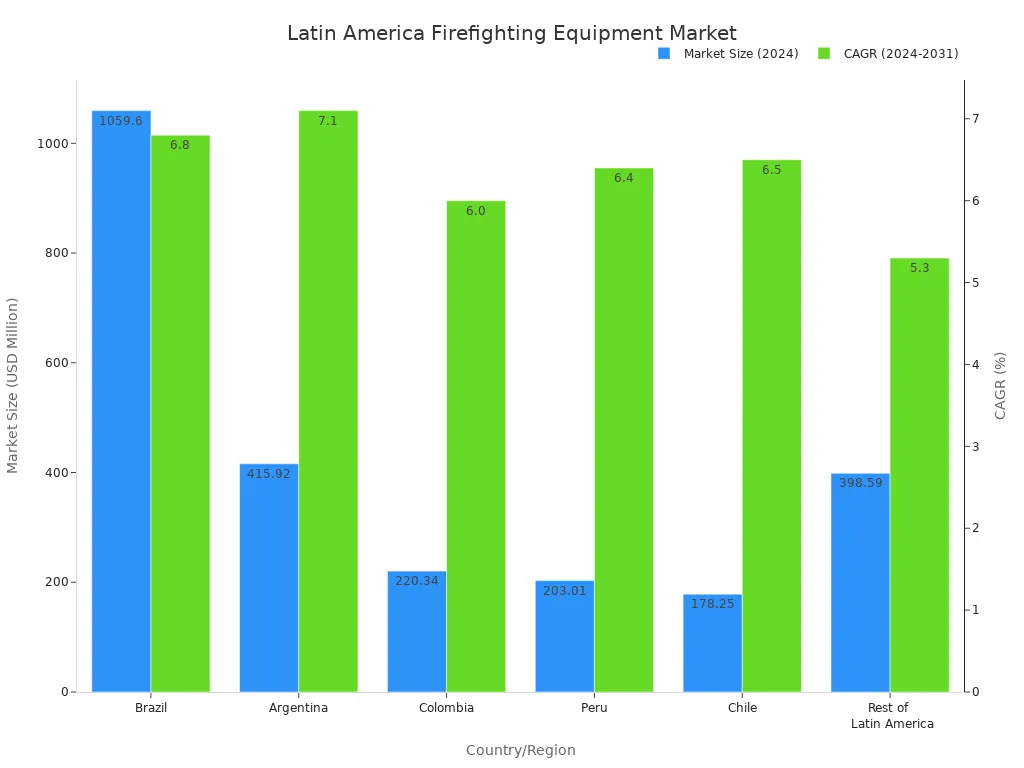
Latin America and Africa offer emerging opportunities for fire fighting equipment. South America’s market expects a 6.2% CAGR from 2024 to 2031. It will reach USD 2475.71 million in 2024. Brazil (6.8% CAGR) and Argentina (7.1% CAGR) show strong growth.
| Country/Region | Market Size (2024) | CAGR (Forecast Period) | Key Drivers |
|---|---|---|---|
| South America | USD 2475.71 million (5% of global revenue) | 6.2% (2024-2031) | Stringent Safety Regulations, Urbanization, Infrastructure Development, Industrial Growth, Heightened Safety Awareness |
| Brazil | USD 1,059.60 million | 6.8% | Infrastructure development, industrial growth, heightened safety awareness |
| Argentina | USD 415.92 million | 7.1% | Urbanization, industrial expansion, focus on safety standards |
| Colombia | USD 220.34 million | 6.0% | N/A |
| Peru | USD 203.01 million | 6.4% | N/A |
| Chile | USD 178.25 million | 6.5% | N/A |
| Rest of Latin America | USD 398.59 million | 5.3% | N/A |
 |
|||
| Stricter safety rules, urbanization, and industrial growth drive these markets. Heightened safety awareness also plays a role. |
Geopolitical Factors and Supply Chains for Fire Fighting Equipment
Geopolitical factors and supply chain disruptions significantly impact manufacturing. Tensions, component shortages, and logistical issues create challenges. Manufacturers use diversified sourcing and local production to reduce risks. Advanced supply chain management, like real-time tracking, helps. Strategic safety stock levels and strong supplier relationships improve agility. Geopolitical risks can also slow innovation, especially for new technologies like electric fire trucks. Companies may hesitate to invest in new markets.
Future Outlook and Strategic Considerations for Fire Fighting Equipment
The future of fire safety looks promising. It brings new challenges and exciting opportunities. Manufacturers must plan strategically. They need to embrace innovation and adapt to a changing world.
Cybersecurity in Connected Fire Fighting Systems
Connected fire fighting systems offer great benefits. However, they also face cybersecurity threats. These include radio frequency jamming and remote code execution. Attackers can cause false alarms or unsafe operations. To fight these threats, companies use network segmentation. They also update malware protection. Training staff on vulnerabilities helps a lot. Disabling insecure protocols and changing default passwords are also key steps. Firewalls provide strong security. They block unauthorized access.
Workforce Training for Advanced Fire Fighting Equipment
New technologies need skilled operators. Workforce training is crucial for advanced fire fighting equipment. Programs like the Blue Card® Hazard Zone Incident Command Training are vital. This program includes online training and a 3-day simulation lab. It covers incident management and tactics. Comprehensive firefighting courses teach improved emergency response. They also cover using various tools. Certifications like NFPA 1001 (Firefighter I & II) are essential. They ensure firefighters can operate complex equipment safely and effectively.
Collaborative Innovation in Fire Fighting Equipment Manufacturing
No single company can solve all challenges. Collaborative innovation is important. Manufacturers, tech companies, and fire departments should work together. This partnership speeds up development. It also ensures new solutions meet real-world needs. Sharing knowledge and resources leads to better, safer products.
Customization and Modularity of Fire Fighting Equipment
Customization and modularity offer great flexibility. Equipment can be quickly adapted for different emergencies. Modular designs allow rapid deployment of tools like water tanks and hoses. Systems can transfer between vehicles. This reduces downtime. It also ensures continuous operations. This flexibility means vehicles can adapt for wildfire season or industrial response. It also lowers long-term costs. Components can be reused across vehicles.
Investment in Research and Development for Fire Fighting Equipment
Investing in research and development (R&D) is critical. It drives future advancements in fire fighting equipment. R&D leads to new materials and smarter systems. It helps create more effective and safer solutions. This continuous investment ensures the industry stays ahead of evolving fire risks.
The fire fighting equipment industry must adapt and innovate continuously. This ensures they meet evolving challenges. It also prepares everyone for a technologically advanced and safer future. Manufacturers demonstrate an unwavering commitment to protecting lives and property. They develop cutting-edge solutions and embrace new technologies.
FAQ
How do AI and IoT make fire fighting better?
AI and IoT make fire fighting smarter. They predict fires, optimize resource use, and enhance decision-making. This leads to faster, more effective responses.
What makes fire fighting equipment sustainable today?
Manufacturers use recycled materials and eco-friendly processes. They also develop electric fire trucks. This reduces environmental impact and promotes greener operations.
Which regions show the most growth for fire fighting equipment?
The Asia-Pacific region, especially India and Southeast Asia, shows significant market expansion. Latin America and Africa also offer emerging growth opportunities.