
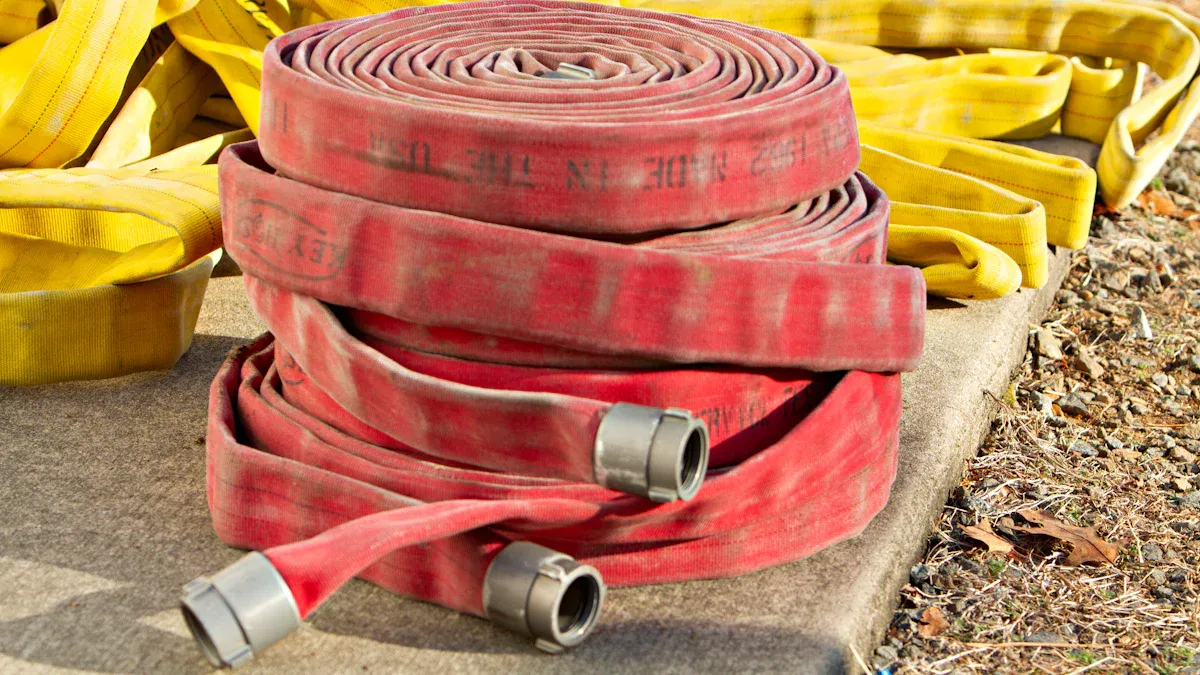
Understanding the different fire hose types is vital for ensuring effective industrial fire safety measures. Each industry has unique requirements, making specific fire fighting equipment essential for optimal performance. For instance, the municipal fire service uses fire hoses for diverse applications, including residential areas and special properties. Over one-quarter of reported fires in the U.S. occurred in home environments from 2013 to 2017, highlighting the need for proper fire fighting equipment. Selecting the right fire hose, such as PVC fire hoses or high-pressure fire hoses, can significantly impact safety and efficiency, particularly in industrial fire safety applications. Additionally, it is important to consider which hose suits chemical factories to ensure the best protection against potential hazards.
Key Takeaways
- Understanding fire hose types is crucial for effective fire safety in industries. Each type serves specific needs, enhancing safety and efficiency.
- Rubber fire hoses are ideal for industrial use due to their durability and chemical resistance. They handle high-pressure situations well.
- PVC fire hoses are lightweight and flexible, making them suitable for commercial settings. However, they have limitations in extreme temperatures.
- Double jacket fire hoses offer excellent abrasion resistance and are used in firefighting and industrial applications. They withstand high pressures effectively.
- Regular inspection and maintenance of fire hoses are essential. This ensures they remain functional and meet safety standards.
Fire Hose Types: Rubber Fire Hoses
Construction and Features
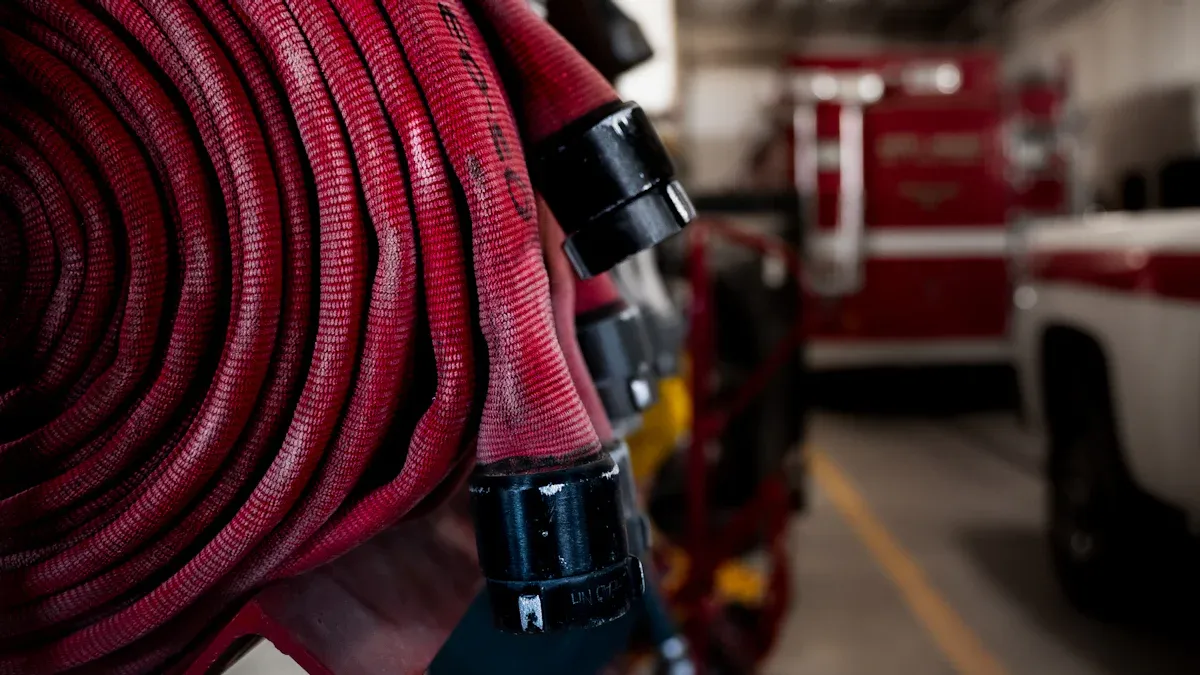
Rubber fire hoses are known for their robust construction and versatility. They typically consist of several key materials that enhance their performance:
| Material Type | Description |
|---|---|
| Inner Lining | Made from rubber compounds or thermoplastic materials, designed to resist internal pressure. |
| Reinforcement Layers | Provide structural integrity and flexibility, often crafted from synthetic fabrics. |
| Outer Jackets | Protect the inner components from environmental damage, usually made from durable fabrics. |
| Couplings | Connect hoses to water sources, constructed from metal or durable plastic. |
Rubber-lined hoses offer excellent resistance to chemicals and high-pressure surges. They maintain flexibility and integrity under repeated folding and deployment, making them suitable for various industrial applications.
Applications in Industrial Settings
Rubber fire hoses find extensive use in industries such as manufacturing, construction, and chemical processing. Their durability and resistance to harsh conditions make them ideal for:
- Firefighting in industrial plants: They can handle high-pressure water flows necessary for extinguishing fires.
- Chemical spills: Their chemical resistance allows for safe handling of hazardous materials.
- Construction sites: They provide reliable water supply for firefighting and dust suppression.
Advantages and Limitations
Rubber fire hoses come with several advantages:
- They are lightweight, reducing physical strain on firefighters.
- Their flexibility allows for easy maneuverability in tight spaces.
- They can withstand high temperatures and pressures, ensuring reliability during emergencies.
However, there are limitations to consider:
| Limitation | Description |
|---|---|
| Vulnerability to extreme temperatures | Less suitable for environments with extremely high temperatures or pressures. |
| Degradation from UV exposure | Prolonged UV exposure can gradually degrade material integrity. |
Understanding these factors helps industries select the right fire hose types for their specific needs.
Fire Hose Types: PVC Fire Hoses
Construction and Features
PVC fire hoses feature a unique construction that enhances their usability in various commercial settings. The following table outlines the key components and materials used in their design:
| Component | Material Used | Function/Benefit |
|---|---|---|
| Base Layer | PVC | Lightweight and durable structure for easy handling and deployment |
| Reinforcement | Woven synthetic fibers (polyester/nylon) | Enhances tensile strength and pressure resistance |
| Inner Lining | Rubber/Cotton/Foam | Provides resistance to chemicals, heat, and maintains flow efficiency |
| Outer Jacket | PVC-coated fabric | Offers abrasion resistance, visibility, and UV protection |
| Couplings | Brass/Aluminum/Stainless Steel | Ensures reliable, leak-free connections and compatibility with firefighting equipment |
Applications in Commercial Use
PVC fire hoses serve various commercial sectors, making them a popular choice for fire safety. The following table highlights some of the primary applications:
| Commercial Sector | Application Description |
|---|---|
| Commercial Buildings | Used in standpipes and hose stations for quick access during fires. |
| Industrial Facilities | Employed for fire suppression and emergency response due to resistance to oils/solvents. |
| Outdoor Firefighting | Utilized for brush, grass, or wildland fires where portability is crucial. |
| Marine & Mobile Units | Lightweight hoses used in boats and fire trailers for ease of deployment. |
Advantages and Limitations
PVC fire hoses offer several advantages that make them suitable for commercial use:
- Durability: PVC fire hoses withstand high-stress firefighting environments.
- Flexibility: They maneuver easily around obstacles, ensuring quick deployment.
- Chemical Resistance: These hoses resist various chemicals, making them versatile for different environments.
- Ease of Maintenance: PVC hoses are easy to clean and maintain, ensuring longevity.
However, they also have limitations that users should consider:
| Drawback | Description |
|---|---|
| Limited Temperature Resistance | PVC hoses can deform or melt at temperatures outside the range of -10°C to 60°C, making them unsuitable for high or low temperature environments. |
| Chemical Compatibility Issues | PVC is susceptible to damage from certain chemicals, which can lead to leaks and health risks in environments where chemicals are present. |
| Durability and Abrasion Resistance | PVC is relatively soft and prone to wear, making it less durable in rough handling situations compared to hoses made from rubber or metal. |
| Fire Hazard | PVC is flammable and can release toxic gases when burned, posing a significant risk in commercial settings where fire safety is a concern. |
| Environmental Impact | The production and disposal of PVC have significant environmental implications, including the release of toxic chemicals and long decomposition times in landfills. |
Understanding these factors helps businesses select the appropriate fire hose types for their specific needs.
Fire Hose Types: Double Jacket Fire Hoses
Construction and Features
Double jacket fire hoses feature a unique design that enhances their durability and performance. These hoses consist of two layers of woven synthetic fabric that encase a rubber lining. This construction provides structural support and protects against external abrasions and cuts. The hoses are engineered to withstand high working pressures, typically between 250 to 300 psi, with burst pressures exceeding 900 psi. This makes them suitable for both firefighting and industrial applications.
Applications in Fire Departments
Fire departments utilize double jacket fire hoses for various critical functions. Their reliability and ease of deployment make them standard equipment on fire engines and wildland firefighting units. Key applications include:
- Firefighting: Essential for combating structural and wildland fires.
- Construction & Mining: Used for dewatering, dust suppression, and equipment cooling in harsh environments.
- Marine & Offshore: Resistant to saltwater corrosion and UV exposure, ideal for shipboard firefighting and offshore platforms.
- Military & Emergency Services: Trusted for mobile operations requiring rugged, portable water delivery systems.
- Manufacturing & Industrial: Employed in high-pressure cleaning, fluid transfer, and emergency deluge systems.
Advantages and Limitations
Double jacket fire hoses offer several advantages:
- They provide excellent abrasion resistance, enhancing longevity.
- Their robust construction allows for high-pressure applications.
- They maintain flexibility, making them easier to handle in various situations.
However, users should consider some limitations:
- They are less flexible than rubber hoses, especially in cold weather.
- They may have lower burst strength and durability under extreme pressure.
- Repeated folding or kinking can lead to cracking.
- Over time, they can become brittle, particularly in cold climates.
Understanding these factors helps fire departments and industries select the appropriate fire hose types for their specific needs.
Fire Hose Types: Single Jacket Fire Hoses
Construction and Features
Single jacket fire hoses consist of a single layer of woven synthetic material, typically nylon or polyester. This construction provides several benefits:
- Jacket Materials: The outer jacket is made from tightly woven synthetic materials that resist tearing and abrasion.
- Liner Materials: The inner lining often uses rubber compounds or thermoplastic materials, with EPDM being a common choice due to its water resistance.
- Strength and Flexibility: These hoses are lighter and more flexible than double-jacket hoses, making them easier to handle in various situations.
Applications in Agriculture
In agricultural settings, single jacket fire hoses serve essential functions. They are commonly used for:
- Irrigation: Farmers utilize these hoses to deliver water efficiently to crops.
- General Water Pumping: They facilitate quick water transfer for various agricultural needs.
Advantages and Limitations
Single jacket fire hoses offer several advantages for agricultural use:
| Advantage | Description |
|---|---|
| Visibility | The bright color of the hose ensures it can be easily seen in outdoor areas, aiding quick access. |
| Durability | Designed to withstand sunlight, moisture, and rough handling, ensuring long-term functionality. |
| Functionality | Can be connected to various water sources for immediate use in fire emergencies on farms. |
However, users should also consider some limitations:
- These hoses are designed for light use, indicating limited durability.
- They are not intended for firefighting, suggesting limitations in pressure handling compared to other hose types.
- The maximum working pressure is 225 PSI at 70°F and 135 PSI at ambient temperature, which may not be sufficient for all agricultural applications.
Understanding these factors helps farmers and agricultural professionals select the right fire hose types for their specific needs.
Fire Hose Types: Fire Hose Reels
Construction and Features
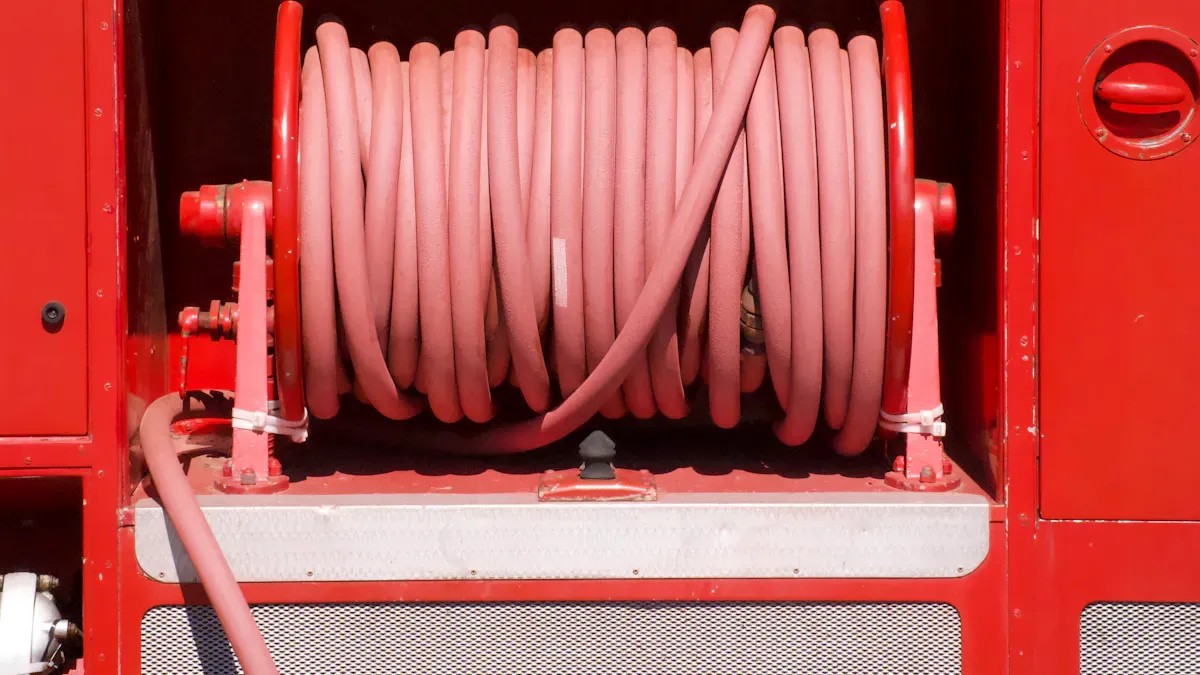
Fire hose reels consist of a cylindrical spool that holds a fire hose. The design allows for easy deployment and retraction of the hose. Key components include:
- Hose Material: Typically made from durable rubber or PVC, ensuring flexibility and resistance to wear.
- Reel Frame: Constructed from metal or high-strength plastic, providing stability and support.
- Mounting Bracket: Allows for secure installation on walls or in cabinets, ensuring accessibility.
Applications in Residential and Commercial Buildings
Fire hose reels play a crucial role in enhancing fire safety in various environments. They enable:
- Immediate Response to Fire: Fire hose reels allow quick action to control small fires, preventing escalation and minimizing damage.
- Easy Operation: Anyone can use them with minimal training, ensuring accessibility during emergencies.
- Continuous Water Supply: Unlike extinguishers, hose reels provide a constant water flow, essential for managing larger fires.
- Versatile Usage: Suitable for different fire types, making them effective in environments like warehouses and offices.
Advantages and Limitations
Fire hose reels offer several advantages that enhance building safety:
- Immediate Response: They enable quick action to control small fires, preventing escalation.
- User-Friendly: Accessible for all employees, requiring minimal training.
- Ongoing Water Supply: They provide continuous water for extended firefighting efforts.
- Versatile Applications: Effective on various fire types, suitable for diverse workplace environments.
However, there are limitations to consider:
- Space Requirements: Fire hose reels require adequate space for installation and operation.
- Maintenance Needs: Regular checks and maintenance are necessary to ensure functionality.
- Potential for Misuse: Improper use can lead to ineffective firefighting efforts.
Understanding these factors helps organizations select the right fire hose types for their specific needs.
In summary, understanding the five fire hose types—rubber, PVC, double jacket, single jacket, and fire hose reels—enables industries to enhance their fire safety measures. Each type serves distinct purposes, making it crucial to match the fire hose type to specific industry needs. For instance, specialized hoses, such as chemical-resistant and high-temperature hoses, are essential for specific hazards.
Important questions to consider include:
- Does my fire hose meet the minimum standards?
- Will it connect to the necessary water sources?
- Is the hose durable and easy to maintain?
By assessing individual requirements, organizations can select the most effective fire hose types for their operations, ensuring safety and efficiency.
FAQ
What is the best fire hose type for industrial use?
Rubber fire hoses are often the best choice for industrial use due to their durability, flexibility, and resistance to chemicals. They can handle high-pressure situations and are suitable for various applications, including firefighting and chemical spills.
How often should fire hoses be inspected?
Fire hoses should undergo inspections at least once a year. Regular checks ensure they remain in good condition and meet safety standards. Additionally, inspect hoses after each use for any signs of wear or damage.
Can PVC fire hoses be used in extreme temperatures?
PVC fire hoses are not suitable for extreme temperatures. They typically perform well between -10°C and 60°C. Outside this range, they may deform or lose functionality, making them less reliable in harsh conditions.
Are fire hose reels easy to operate?
Yes, fire hose reels are designed for easy operation. They allow quick deployment and retraction of hoses, making them accessible for anyone during emergencies. Minimal training is required for effective use.
How do I maintain my fire hose?
To maintain a fire hose, regularly inspect it for damage, clean it after use, and store it properly. Ensure it remains dry and free from kinks or sharp bends to prolong its lifespan.