
Compliance Standards for Commercial Fire Extinguisher Placement
According to the National Fire Protection Association (NFPA) 10, commercial buildings must adhere to strict guidelines regarding the selection, distribution, and maintenance of portable fire suppression equipment. Compliance ensures that occupants can effectively suppress small fires before they escalate into catastrophic events. The core requirement mandates that fire extinguishers be readily accessible, fully charged, and appropriate for the specific hazards present within the facility. Building owners must integrate these devices into a comprehensive life safety strategy that aligns with Occupational Safety and Health Administration (OSHA) regulations and local building codes to mitigate property damage and ensure life safety.
Technical Classifications of Commercial Fire Extinguishers
Fire hazards in commercial environments are categorized into five distinct classes based on the fuel source. Selecting the correct portable fire extinguisher is critical, as using an incorrect agent can exacerbate the fire. For instance, applying water to a Class B grease fire causes rapid expansion and splashing, spreading the flames. Most offices and retail spaces utilize ABC Dry Chemical units, which contain monoammonium phosphate. This agent is effective against ordinary combustibles, flammable liquids, and energized electrical equipment. Understanding these classifications allows facility managers to procure the specific hardware required for their unique risk profiles.
Fire Class and Agent Compatibility
| Fire Class | Combustible Materials | Suitable Extinguishing Agents |
|---|---|---|
| Class A | Trash, Wood, Paper, Cloth | Water, Foam, Multipurpose Dry Chemical |
| Class B | Flammable Liquids, Oils, Paints | Carbon Dioxide (CO2), Dry Chemical |
| Class C | Energized Electrical Equipment | Carbon Dioxide (CO2), Halotron, Dry Chemical |
| Class D | Combustible Metals (Magnesium, Sodium) | Dry Powder Agents |
| Class K | Commercial Cooking Oils and Fats | Wet Chemical Agents |
OSHA Regulations and NFPA 10 Travel Distance Requirements
The Occupational Safety and Health Administration (OSHA) 1910.157 standard dictates the maximum travel distance an employee must cover to reach a fire suppression device. For Class A hazards, the maximum travel distance is 75 feet. In contrast, Class B hazards require a shorter distance of 50 feet due to the rapid rate of fire spread associated with flammable liquids. Implementing a fire extinguisher cabinet ensures that units remain protected from environmental damage while staying visible. Proper placement must also consider the height of the unit; extinguishers weighing less than 40 pounds must be installed so the top is no more than 5 feet above the floor.
Calculated Fire Extinguisher Ratings for Building Occupancy
Fire extinguisher effectiveness is measured by a numerical rating system (e.g., 2-A:10-B:C). The “A” rating represents the equivalent of 1.25 gallons of water per unit, while the “B:C” rating indicates the square footage of a Class B fire a non-expert operator can extinguish. According to NFPA Statistical Data, portable extinguishers are effective in 95% of fire incidents when used correctly. For high-hazard areas like industrial workshops, a heavy-duty fire extinguisher with a higher numerical rating is required to provide sufficient suppression capacity. Calculating the total floor area against the hazard level determines the minimum number of units needed for full coverage.
Minimum Extinguisher Ratings by Floor Area
| Hazard Level | Scenario | Coverage Area | Rating |
|---|---|---|---|
| Light Hazard | Offices, Schools | 3,000 sq. ft. | 2-A |
| Ordinary Hazard | Retail, Warehouses | 1,500 sq. ft. | 2-A |
| Extra Hazard | Manufacturing, Labs | 1,000 sq. ft. | 4-A |
Monthly Visual Inspections and Annual Maintenance Protocols
Systematic maintenance is a mandatory component of fire safety compliance. Building owners must conduct monthly visual inspections to verify that the pressure gauge needle remains in the green “operable” zone and that the safety pin is intact. Furthermore, NFPA 10 Section 7.3 requires an annual thorough examination by a certified fire protection professional. Every six years, stored-pressure extinguishers must undergo internal maintenance, which involves discharging the agent and inspecting internal components. These records must be maintained on a tag attached to the unit or stored in a digital log to demonstrate compliance during fire marshal inspections.
Hydrostatic Testing Intervals for Pressure Vessel Integrity
Hydrostatic testing is a critical safety procedure used to verify the structural integrity of the fire extinguisher cylinder. Over time, moisture and corrosion can weaken the metal, potentially leading to a catastrophic failure under pressure. Carbon dioxide ($CO_2$) and wet chemical cylinders require testing every 5 years, while dry chemical units typically require testing every 12 years. If a cylinder fails to meet the standards set by the Department of Transportation (DOT), it must be decommissioned and replaced. Utilizing a high-pressure fire hose during testing ensures that the vessel can withstand pressures significantly higher than its normal operating range.
Strategic Signage and Mounting for Emergency Visibility
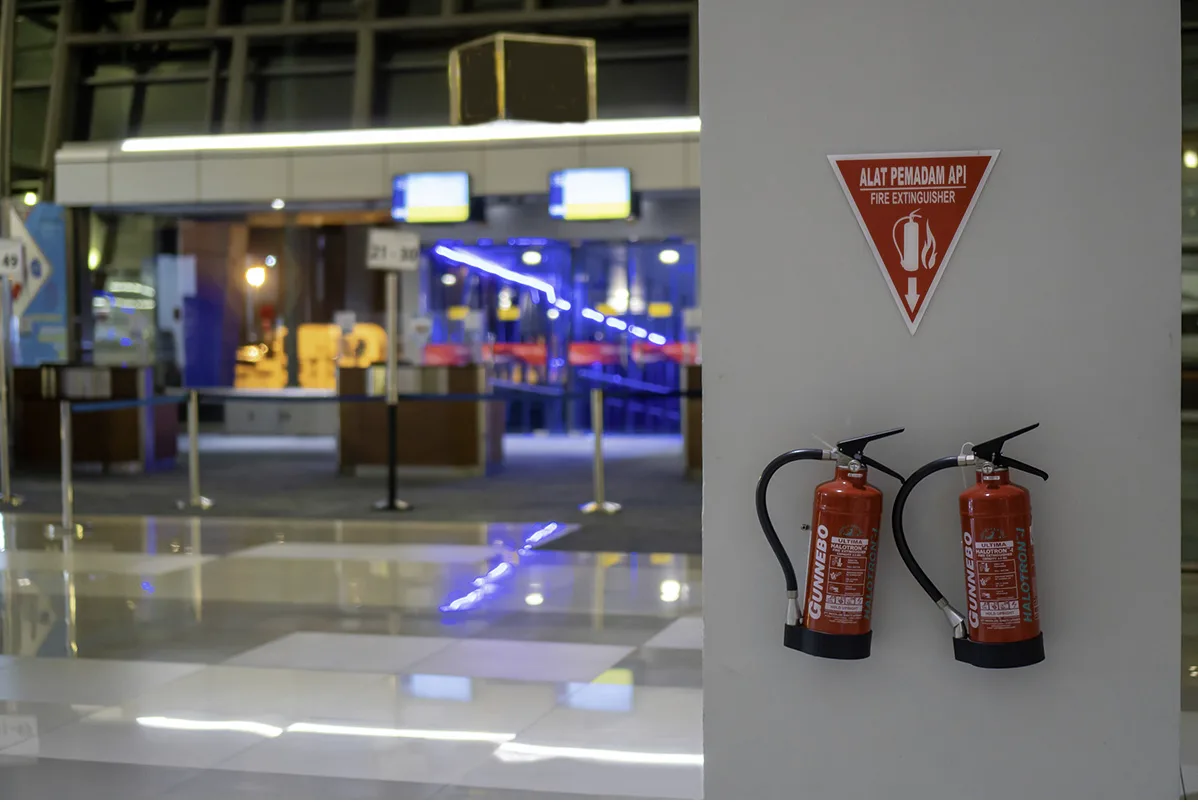
The visibility of fire safety equipment is a primary factor in response time during an emergency. OSHA 1910.157(c)(1) specifies that extinguishers must be mounted in locations that are readily accessible and identified by highly visible signage. In large commercial spaces, 3D or projecting signs are recommended so the equipment can be located from multiple angles. For facilities with aesthetic concerns, a recessed fire extinguisher box provides a flush-mount solution that meets ADA (Americans with Disabilities Act) protrusion limits while maintaining immediate access. Failure to provide clear pathing or obstructing equipment with inventory can result in significant fines and increased liability.
Enhancing Commercial Fire Safety with Automatic Systems
While portable extinguishers are the first line of defense, they are often supplemented by automatic fire suppression systems in high-risk zones. In server rooms or chemical storage areas, automatic fire suppression kits utilize sensors to detect heat and release extinguishing agents without human intervention. This is particularly important for 24-hour facilities where staff may not be present in all areas. These systems work in tandem with portable units to provide a multi-layered defense strategy. Data from the U.S. Fire Administration (USFA) suggests that buildings equipped with both portable and automatic systems experience 60% less property damage during fire events.
FAQ
What is the difference between a fire extinguisher inspection and maintenance?
An inspection is a quick monthly visual check to ensure the unit is available and functional. Maintenance is a detailed annual service performed by a licensed technician who examines mechanical parts, extinguishing agents, and the delivery system. Both are required by NFPA 10 to ensure the equipment operates correctly during an emergency.
How do I determine the hazard level of my commercial building?
Hazard levels are classified as Light, Ordinary, or Extra based on the quantity and combustibility of contents. Offices are typically Light Hazard, while a woodworking shop is Extra Hazard. Consulting the International Building Code (IBC) or a local fire marshal is necessary to accurately categorize your facility’s specific risk profile.
Can I mount a fire extinguisher directly on the floor?
No, fire extinguishers must be mounted on brackets or placed in cabinets. Units weighing less than 40 lbs must have the top no higher than 5 feet from the floor; units over 40 lbs must be no higher than 3.5 feet. The bottom of the extinguisher must always be at least 4 inches above the floor.
When should a commercial fire extinguisher be replaced rather than recharged?
Replacement is necessary if the cylinder fails a hydrostatic test, shows signs of significant corrosion, has a damaged handle, or if the manufacturer’s labels are illegible. Additionally, many older “disposable” dry chemical units are designed for one-time use and cannot be recharged after any amount of discharge.
Do fire extinguishers in commercial vehicles have different requirements?
Yes, commercial motor vehicles (CMVs) must follow FMCSA 393.95 regulations. Power units must generally carry an extinguisher with an Underwriters’ Laboratories rating of 5-B:C or more. If the vehicle transports hazardous materials, the requirement increases to a 10-B:C rating to handle more volatile flammable liquid risks.