
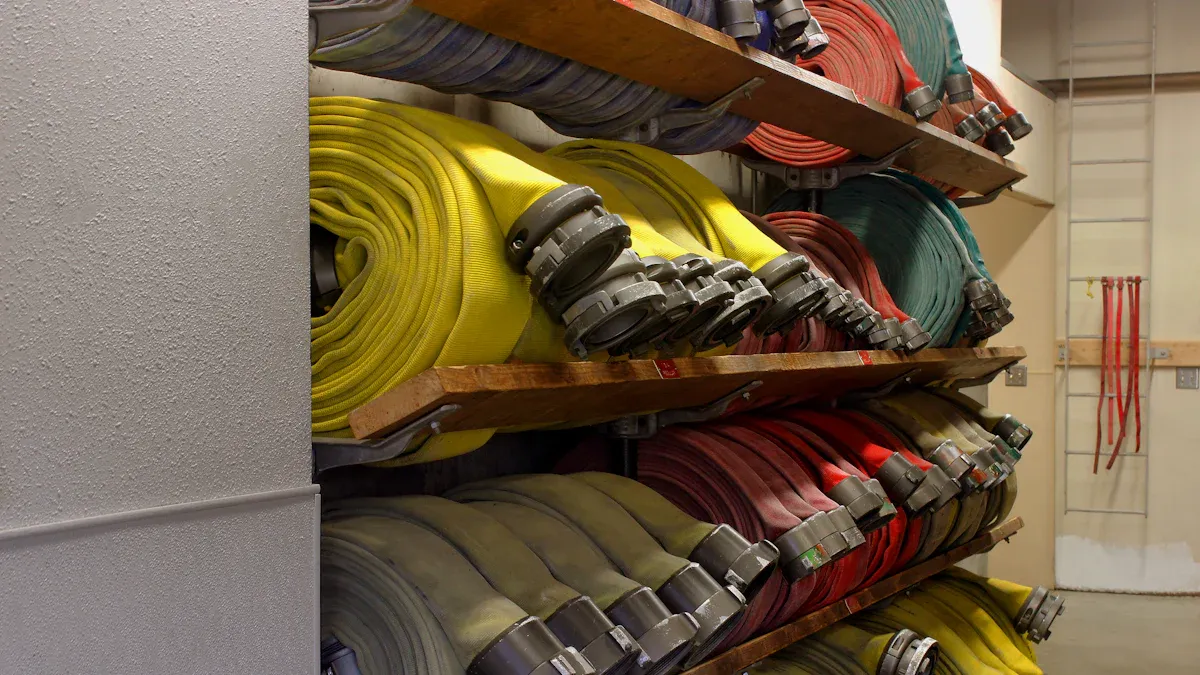
Single jacket fire hoses use one woven layer. Double jacket hoses have two protective layers. Rubber fire hoses offer high durability. This blog compares these Fire Fighting Equipment options. It guides informed selection from a Fire Fighting Equipment Manufacturer or Fire Fighting Equipment Supplier. They provide OEM/ODM Fire Fighting Products, including Fire Extinguisher and Fire Hydrant Valve units.
Key Takeaways
- Single jacket hoses are light and cheap. They work best for wildland fires where you need to move fast.
- Double jacket hoses are strong and last long. They are good for city fires where hoses face rough surfaces.
- Rubber hoses resist chemicals and need little care. They are great for places with oil or harsh liquids.
Single Jacket Fire Hoses: Essential Fire Fighting Equipment
Construction and Characteristics
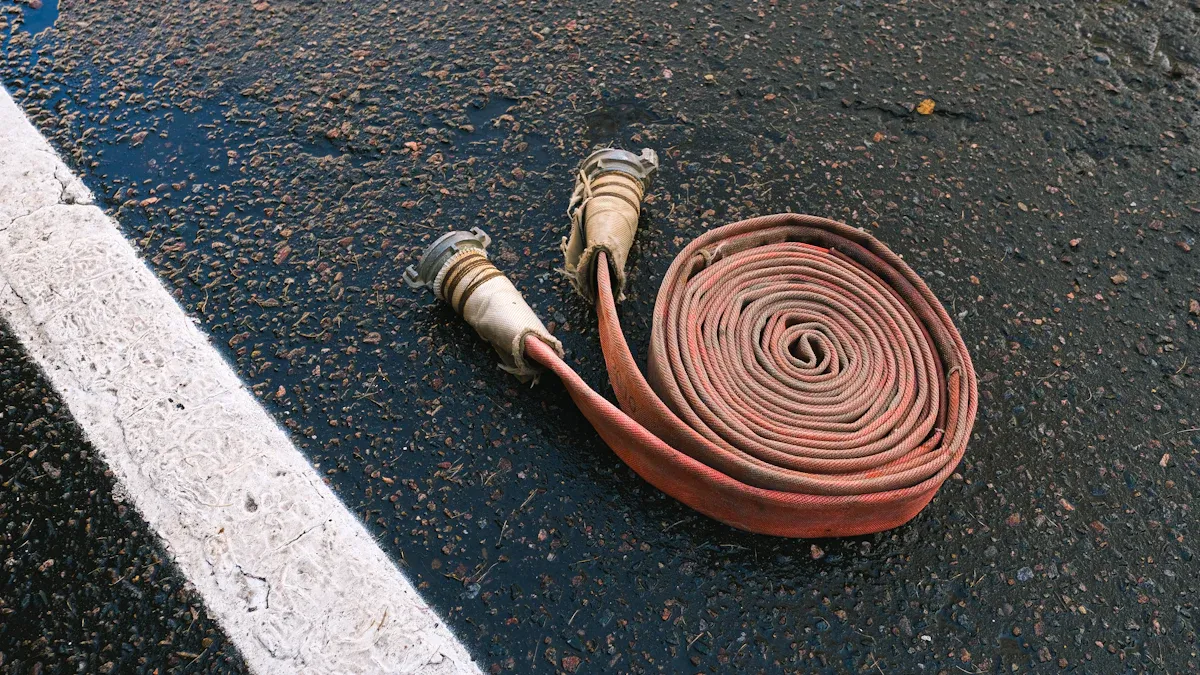
Single jacket fire hoses feature a straightforward design. They consist of an inner lining and a single outer jacket. The inner lining typically uses synthetic rubber compounds, EPDM (ethylene propylene diene monomer), or thermoplastic materials. These materials create a waterproof barrier, minimize friction loss, and resist mildew, ozone damage, and chemical degradation. The outer jacket comprises high-strength synthetic fibers, often polyester, nylon, or a blend. Polyester provides excellent abrasion resistance and maintains strength when wet. Nylon offers superior flexibility and lighter weight. Manufacturers often combine these fibers for optimized durability and handling.
Advantages and Limitations
Single jacket fire hoses offer distinct advantages. They are significantly lighter, often 30-40% less heavy than comparable double jacket hoses. This reduced weight improves firefighter mobility and operational efficiency. Their single layer construction also makes them more flexible, allowing for easier coiling and storage. Furthermore, these hoses present a lower initial purchase price, making them a more economical option. This cost-effectiveness is particularly valuable for wildland operations, enabling larger hose inventories. However, single jacket hoses have limitations. They are inherently less resistant to abrasion. Their reduced material thickness makes them more vulnerable to damage when exposed to sharp objects and rough surfaces. This means they are less ideal for environments with significant abrasive contact, such as structural firefighting.
Primary Applications
The characteristics of single jacket fire hoses make them suitable for specific applications. Their lightweight and flexible nature makes them ideal for wildland firefighting, where maneuverability over varied terrain is crucial. They are also a cost-effective choice for situations requiring a large volume of hose. Some industrial applications, such as mine hoses, utilize a single jacket exterior from polyester to reduce weight and increase flexibility while resisting gravitational pressure. These hoses are generally best for occasional, light use where extreme abrasion resistance is not the primary concern for the Fire Fighting Equipment.
Double Jacket Fire Hoses: Enhanced Fire Fighting Equipment
Construction and Characteristics
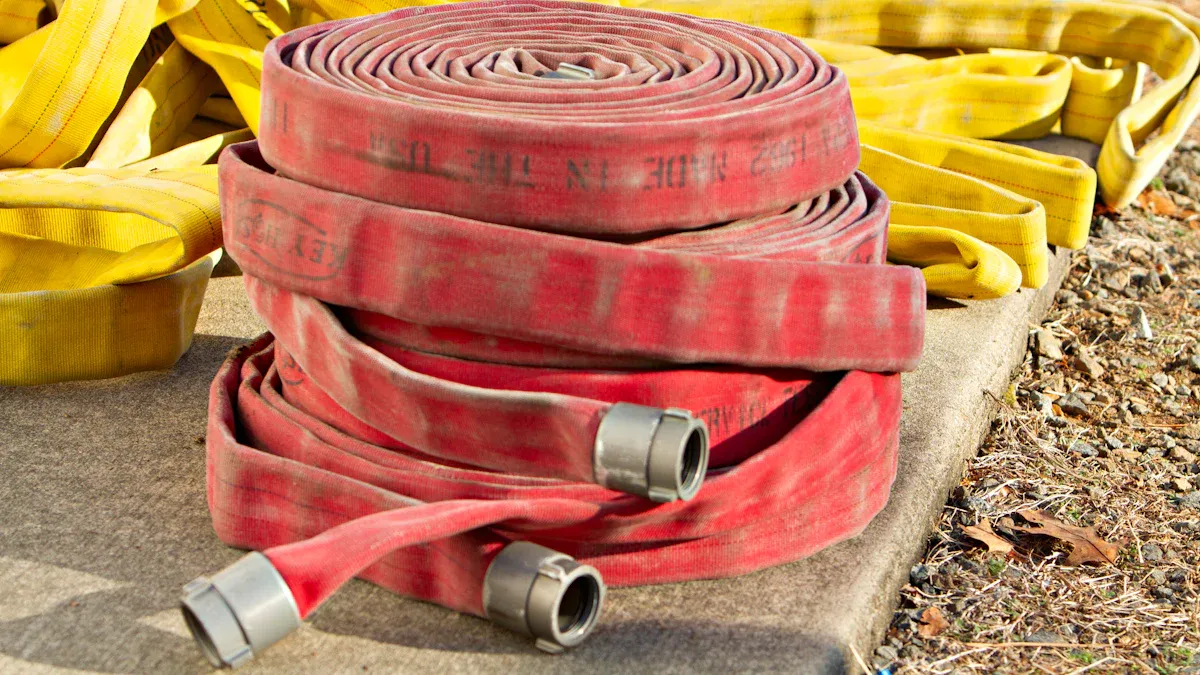
Double jacket fire hoses feature a robust design. They include an inner rubber liner, similar to single jacket hoses, which ensures water tightness and reduces friction. Surrounding this liner are two distinct woven jackets. Manufacturers typically construct these jackets from high-strength synthetic fibers like polyester or nylon. The dual-layer construction provides significant reinforcement and protection against external damage.
Advantages and Limitations
Double jacket hoses offer superior durability. They exhibit high resistance to abrasion, cuts, and heat. This makes them the preferred choice for structural firefighting. Hoses frequently encounter harsh surfaces like concrete, asphalt, building materials, and vehicular traffic in these environments. The dual-layer design distributes stress across both jackets. This reduces wear on the inner lining and extends the hose’s service life. Fire departments in urban and suburban environments often experience longer service life from double jacket hoses due to their enhanced durability. These hoses also boast higher pressure ratings, often exceeding 300 PSI, with some models rated for 400 PSI. This allows them to handle greater water pressure effectively. However, double jacket hoses are heavier and less flexible than single jacket options. Their increased material and construction also lead to a higher cost.
Primary Applications
Fire departments widely use double jacket hoses for structural firefighting. Their robust construction withstands the demanding conditions of burning buildings and urban environments. They are also suitable for industrial applications where durability and high-pressure capabilities are essential. Their enhanced protection makes them reliable Fire Fighting Equipment for critical operations.
Rubber Fire Hoses: Durable Fire Fighting Equipment
Construction and Characteristics
Rubber fire hoses feature a robust, integrated design. They typically consist of an inner tube and an outer cover made from nitrile rubber. This material provides excellent waterproofing and chemical resistance. Manufacturers reinforce the hose with 100% synthetic yarn, often a blend of circular woven, twill weave polyester, and nylon 6.6 yarn. Polyester prevents snaking under pressure. Nylon allows for controlled dilation, which reduces friction loss and increases flow rates. The construction uses a through-the-weave method, sometimes an interlocking matrix. This ensures the hose remains intact even when exposed to fuels, oil, and most low-concentrated chemicals. This construction eliminates the need for adhesives, ensuring a permanent bond to all warp and weft yarns. A special rubber compound provides a tough cover resistant to heat, abrasion, snags, and hot embers.
Advantages and Limitations
Rubber fire hoses offer significant advantages in durability and performance. They are generally lighter and more flexible than traditional jacketed hoses. Unlike fabric, rubber does not absorb water. This means rubber hoses maintain their lighter weight even when wet, making them easier to pack and store after use. They offer enhanced resistance to water, chemicals, oils, and other compounds that could damage standard hose jackets. These hoses are engineered to resist kinking. They maintain their circular cross-section even when under-pressurized. This design prevents localized wear spots, often called ‘kink-burn.’
| Environmental Factor | Synthetic Rubber Fire Hose | Double-Jacket Textile Hose |
|---|---|---|
| UV and Ozone Resistance | Excellent (Inherent polymers) | Moderate (Requires coatings) |
| Chemical Resistance | High (Resists oil/fuel) | Low (Fibers absorb contaminants) |
| Maintenance Needs | Wipe clean, no drying required | Must be washed and dried (mildew risk) |
Their primary limitation often involves a higher initial cost compared to single jacket options.
Primary Applications
The robust nature and chemical resistance of rubber fire hoses make them ideal for demanding environments. Industries widely use them where exposure to oils, fuels, or corrosive chemicals is common. They are also excellent for marine and offshore applications due to their resistance to saltwater and harsh conditions. Their durability makes them reliable Fire Fighting Equipment for situations requiring minimal maintenance and maximum longevity.
Comparative Analysis of Fire Fighting Equipment Performance
Selecting the right Fire Fighting Equipment requires a detailed understanding of how different hose types perform. This section provides a comparative analysis of single jacket, double jacket, and rubber fire hoses across key performance metrics.
Durability and Abrasion Resistance
Durability and abrasion resistance are critical for hose longevity. Rubber-coated fire hoses offer inherent resistance to abrasions. Polyester jacketed hoses, including both single and double jacket types, provide additional abrasion protection. Double jacket hoses feature an extra layer of polyester. This additional layer significantly enhances their resistance to the elements compared to single jacket hoses. The extra layer of woven fabric in double jacket hoses gives them higher wearability. This protection against wear and damage results in double the service life compared to single jacket counterparts.
Weight, Handling, and Flexibility
Hose weight, handling, and flexibility directly impact firefighter efficiency. Single jacket hoses are notably lighter. They also offer greater flexibility. This makes them easier to deploy and maneuver. Double jacket hoses, while more durable, are heavier. Their dual-layer construction makes them less flexible. This can affect rapid deployment in tight spaces. Rubber hoses generally fall between single and double jacket hoses in terms of weight and flexibility. They offer a good balance for handling and storage.
Pressure Ratings and Burst Strength
Pressure ratings and burst strength indicate a hose’s ability to withstand high water pressures. These factors are crucial for safety and operational effectiveness. The following table compares typical burst pressure ratings for different hose types:
| Hose Type | Burst Pressure (PSI) |
|---|---|
| 1.5" x 50′ Single Jacket | 750 |
| Single Jacket (General) | 900 |
| Double Jacket | 1,200 |
Double jacket hoses consistently demonstrate higher burst pressure ratings. This makes them suitable for high-pressure applications.
Kink Resistance
Kink resistance prevents hose collapse under pressure, ensuring continuous water flow. Single jacket hoses are more prone to kinking due to their lighter construction. Double jacket hoses generally offer superior kink resistance. Manufacturers design many advanced double-jacketed hoses for extreme kink resistance, even at low pressures. Examples include KRAKENEXO®, KRAKENEXO Super II™, Armtex™ Attack™, Combat Sniper, DBAK™, and Cobra Combat. These designs prevent damage from constant working conditions. The specific yarn weave in synthetic woven jacket hoses directly impacts both flexibility and kink resistance. Manufacturers optimize yarn type and weave to enhance a hose’s ability to resist kinking. Rubber hoses also exhibit good kink resistance due to their robust, integrated construction.
Chemical and Heat Resistance
Exposure to chemicals and heat is common in firefighting environments. Rubber-covered fire hoses demonstrate exceptional chemical resistance. They are 100% damage resistant to various substances. These include chemicals, seawater, fuels, grease, acids, ozone, and oils. Exposure to these compounds does not affect their performance. Firefighters can easily clean them after exposure. Their nitrile rubber tube and synthetic yarn reinforcement, with ‘through-the-weave’ construction, prevent material division when exposed to fuels, oil, and most low-concentrated chemicals. The BullDog Red Chief, a nitrile rubber through-the-weave hose, exemplifies this durability. Double jacket hoses also offer good chemical resistance. For instance, the BullDog™ Hi-Combat® Firefighting Hose, a double-jacket type, is known for its high resistance to chemicals. Single jacket hoses offer less inherent chemical resistance compared to rubber or specialized double jacket options.
Cost and Lifespan
Initial cost and expected lifespan are significant factors in procurement decisions. Single jacket hoses are the most economical option. A 1.5" x 50′ single jacket hose typically costs around $85 to $88. They have an expected lifespan of approximately 10 years. Double jacket hoses represent a higher initial investment. However, they offer a significantly longer lifespan, often double that of single jacket hoses, reaching around 20 years. Some double jacket hoses, like the Key Fire Hose ECO-10, come with a 10-year warranty, indicating their expected service life. Rubber fire hoses often have a higher initial cost than both single and double jacket textile hoses. Their superior durability and reduced maintenance needs can lead to a lower total cost of ownership over their extended lifespan.
Choosing Fire Fighting Equipment for Specific Applications
Selecting the correct hose type significantly impacts operational effectiveness and firefighter safety. Different environments and fire scenarios demand specific hose characteristics. This section explores the optimal hose choices for various applications.
Structural Firefighting
Structural firefighting presents some of the most demanding conditions for hoses. Firefighters require hoses that withstand extreme heat, sharp debris, and constant abrasion. Double jacket construction is the standard for municipal structural firefighting. It offers maximum durability and abrasion resistance. This dual-layer jacket system protects against rough surfaces, sharp edges, and vehicle traffic. It handles working pressures from 200 to 400 PSI. Polyester jackets are ideal for structural firefighting applications. They offer excellent abrasion resistance and maintain strength when wet. Attack lines, typically 1.5 to 2 inches in diameter, are recommended for initial fire attack and interior operations in most structural fire situations. Their smaller diameter allows for maneuverability in confined spaces while delivering adequate flow. For example, a 1.75-inch line flows 100 to 200 GPM.
Wildland Firefighting
Wildland firefighting operations prioritize lightweight and maneuverability due to challenging terrain and long distances. Single jacket construction offers a lighter-weight alternative. This makes it suitable for applications where reduced weight and increased maneuverability are prioritized over maximum abrasion resistance. Firefighters frequently use it in forestry and wildland firefighting. They often need to carry equipment over long distances through challenging terrain. Aluminum couplings significantly reduce the overall weight of the hose. This benefits wildland operations where firefighters must carry hoses over rough terrain. Forestry hose is specifically designed for wildland crews. It is lightweight and narrow, often 1 inch or less, to facilitate mobility in rugged terrain. It may feature a rubber lining and a synthetic outer jacket. Despite its size, it must meet NFPA standards for service test pressure.
Industrial and Commercial Use
Industrial and commercial settings present diverse fire protection needs. These environments often involve specific hazards like chemicals, oils, or heavy machinery. Double jacket fire hoses feature two layers of spun polyester fabric for durability. They can withstand higher pressures and prolonged use. They are preferred for Class A fires. Rubber-covered fire hoses are constructed to resist ozone, oxidation, and most chemical or petroleum products. The nitrile rubber tube with synthetic yarn reinforcement ensures it will not divide when exposed to fuels, oil, and most low-concentrated chemicals. Industrial mine hoses are engineered with a single jacket exterior of polyester. This provides reduced weight, increased flexibility, and resistance to gravitational pressure and hydrolysis. They are suited for underground mining operations. Marine washdown hoses are designed for rough outdoor conditions. They frequently encounter raw, fresh, and salt water on ships or offshore facilities.
Standpipe and Interior Operations
Standpipe systems provide a ready water source within buildings for fire suppression. Hoses for these systems require specific characteristics for interior use. For light-hazard occupancies in Class II and Class III systems, hoses must be at least 1-inch in diameter. Some fire hoses are specifically designed for rack and reel applications. They are lightweight, listed, and typically 1.5-inch in diameter. The choice of hose also depends on the standpipe class:
| Standpipe Class | Recommended Hose Type/Connection Size |
|---|---|
| Class I | 2.5-inch hose (professional firefighters); 3-inch hose in New York and San Francisco |
| Class II | 1.5-inch hose (for general use, though increasingly shunned) |
| Class III | 1.5-inch hose (for trained personnel) and 2.5-inch hose connections (for professional firefighters); some systems may have 2.5-inch connections with reducers for 1.5-inch hoses |
Marine and Offshore Environments
Marine and offshore environments demand hoses with exceptional resistance to saltwater, chemicals, and harsh weather. Marine fuel systems hoses must be U.S. Coast Guard-approved and marked with J 1527 standards. A1-type hoses are recommended for gasoline uses, especially for fuel lines connecting tanks to engines or generators. They offer reduced permeability and enhanced fire resistance. A2-type hoses are used where slightly lower specifications are acceptable compared to A1. B1-type hoses typically serve diesel applications, including fuel lines for diesel engines and generators. Marine sanitation system hoses are tough, flexible, and resistant to toilet chemicals. They carry waste. Their most important feature is odor impermeability, often achieved with smooth bores and heavy built-in barrier layers. Engine cooling system hoses are made from heat-resistant materials. They withstand high and low temperatures. They circulate cooling water or coolant to regulate engine temperature. Specialty marine hoses, such as bilge pump hoses, remove water from the bilge area. They are typically made of flexible and abrasion-resistant materials, potentially with anti-kink properties. Smooth-bore bilge hoses are preferred over corrugated for greater flow and efficiency. Specific examples include SERIES 120 Bilge Pump Hose for abrasion and acid resistance, and SERIES 148 Smooth Flex FDA Sanitation Hose for both above and below waterline applications. For offshore oil operations, specialized hoses like SERIES 297 Daytona Type Mainline Submarine Hose handle fuels with up to 60% aromatic content.
Maintenance and Care for Fire Fighting Equipment
Proper maintenance and care significantly extend the lifespan and reliability of all Fire Fighting Equipment. Adhering to established protocols ensures hoses perform optimally during critical operations.
Cleaning and Drying Procedures
Firefighters clean all hoses after each use. If dirt cannot be thoroughly brushed off, or if the hose contacts harmful materials, they wash it. Hoses exposed to hazardous materials undergo decontamination by an approved method. Covered hoses, including rubber fire hoses, are permitted to be wiped dry. Firefighters do not dry hoses on hot pavements or under intense sunlight. Before washing, they unroll the hose on a clean surface, stretch it out, and remove any kinks. They use a clean, dry brush with soft to medium bristles; they do not use a power washer or solvent. They repeat the brushing process for both sides of the hose. Firefighters wash the hose with a garden hose or other low-pressure water source. For hoses covered with rubber, nitrile, or other protective exteriors, they wipe the hose dry. Other hose types can dry on a tower or rack. If using a commercial hose dryer, firefighters ensure the inside of the hose drains completely.
Inspection and Testing Protocols
Industry standards, primarily NFPA 25 and NFPA 1962, guide fire hose inspection and testing. Monthly visual inspections are required. More comprehensive quarterly inspections and annual service testing also occur. All inspections are documented, with records maintained for at least one year. Annual inspection records are kept for the life of the system. Trained individuals knowledgeable about fire protection systems and standards conduct inspections. An annual functional test involves fully unwinding the hose, verifying water flow, checking nozzle operation, and ensuring proper rewinding. A 5-year pressure test requires applying service test pressure per standards. This ensures the hose maintains pressure without failure. Firefighters check for leaks at couplings and record test pressure on a tag.
Storage Recommendations
Optimal storage conditions maximize the lifespan of fire hoses. Firefighters store hoses in cool, dry, and well-ventilated areas, away from direct sunlight. Ideal temperatures range from 40-90°F (4.4-32.2°C) with relative humidity below 60%. They protect stored hoses from petroleum products, chemicals, and automotive fluids, as these can damage both jacket materials and rubber linings. Firefighters avoid areas with vehicle exhaust or chemical fumes. They utilize vertical or horizontal storage racks specifically designed for fire hoses. This evenly supports their weight and prevents stress concentrations. Adequate spacing between hose sections allows for proper air circulation. Firefighters regularly rotate fire hose inventory, placing recently tested hoses at the back and moving older hoses forward for use. This ensures all hoses are used and tested regularly.
Single jacket hoses offer lightweight economy. Double jacket hoses provide superior durability and pressure resistance. Rubber hoses excel in chemical resistance and low maintenance. Users match hose types to specific operational needs. Consider durability, weight, and cost for optimal selection.
FAQ
What is the main difference between single and double jacket fire hoses?
Single jacket hoses have one woven layer. Double jacket hoses feature two woven layers. The extra layer provides enhanced durability and abrasion resistance.
Which type of fire hose is best for wildland firefighting?
Single jacket fire hoses are ideal for wildland firefighting. Their lightweight and flexible design improves maneuverability over challenging terrain.
What are the key advantages of rubber fire hoses?
Rubber fire hoses offer superior resistance to chemicals, oils, and abrasion. They also require less maintenance and do not absorb water.